
Token FinOps: why AI costs become a board-level issue in 2026
AI costs turned from a side note into a leadership issue in 2026. According to the FinOps Foundation's State of FinOps report, 73 percent of companies exceeded their original AI cost plans, and individual agentic projects overshot their budget by a factor of 2.4. The price per token fell 67 percent between early 2025 and early 2026, down to 6.07 US dollars per million tokens, but consumption grows faster: Meta reports a 30-fold increase in agentic queries within six months, and Uber burned through its annual AI budget in four months. The market is responding with a new tool category. On 14 July 2026, 1Password introduced AI Spend and Consumption Management, which consolidates token consumption across Anthropic, OpenAI, and Cursor in one dashboard. In June, the Linux Foundation launched the Tokenomics Foundation to standardize measurement and pricing. In Germany, 33 percent of companies say AI turned out more expensive than expected. Getting this under control takes a loop of visibility, cost attribution, budgets with alerts, and continuous model steering.
AI costs are running out of control
The bill for the AI buildout has arrived. 73 percent of companies report AI costs above their original forecasts, and even tech corporations with billion-dollar budgets are introducing spending caps. A Financial Times investigation from June 2026 found that Amazon, Walmart, Cisco, Uber, and Meta all restrict internal AI use, urge staff toward frugal habits, or push them onto cheaper models.
Uber is the starkest example. The company burned through its entire 2026 AI budget in four months and then imposed a cap of 1,500 US dollars per employee per month. Walmart limited usage of its internal coding assistant. Amazon scrapped an internal token leaderboard after employees started gaming it.
Financial markets have picked up on the topic too. The word token came up in 129 earnings calls in the second quarter of 2026, up from 57 in the quarter before, according to analysis firm AlphaSense. AI cost control is no longer an internal IT matter. It is now a topic for investors, executives, and boards.
- A review of 127 enterprise agentic AI projects found 73 percent over budget, some by a factor of 2.4.
- Unplanned costs added up to roughly 2.3 million US dollars per affected project.
- Anthropic and OpenAI are shifting parts of their services from flat rates to token-based billing. Costs become more variable and harder to plan.
Why token costs differ from cloud costs
Classic cloud cost accounting no longer works for AI. Mature cloud FinOps teams forecast within 1 to 3 percent of their actual spend. With AI, those same teams miss by a factor of two to three. The reason is a paradox: the price per token keeps falling, yet the total bill keeps rising.
The mature FinOps teams on the cloud are usually forecasting in 1 to 3 percent of where they are going to land. With AI it is totally blown out.
J.R. Storment, Executive Director, FinOps FoundationThe numbers behind it: an analysis of 2.4 billion enterprise API calls shows blended token costs fell 67 percent between the first quarter of 2025 and the first quarter of 2026, from 18.40 to 6.07 US dollars per million tokens. Over the same period, agentic queries at Meta grew 30-fold. An AI agent that solves a task in twenty steps consumes many times the tokens of a single chat prompt. Falling unit prices lose against exploding volume.

Two more traits set AI apart from the cloud era. First, costs vary wildly: between leading models, 1Password cites a cost variance of up to 300x on comparable tasks. Model choice is the single biggest lever. Second, AI spending arises everywhere in the company, in sales, marketing, and legal just as much as in IT. Cloud costs were an engineering topic. AI costs are not.
A case study from a regional bank exposes a third trap. In its AI-supported mortgage workflow, tokens themselves made up only 22 percent of the AI cost per transaction. The rest went to tool calls, vector database queries, human review steps, and compliance. Anyone who only watches the token price badly underestimates the total cost per use case.
New tools and standards: from 1Password to the Tokenomics Foundation
The market is responding with a new product category: token cost management. On 14 July 2026, 1Password introduced AI Spend and Consumption Management, an extension of its SaaS Manager. The tool pulls consumption data from Anthropic, OpenAI, and Cursor daily via their admin APIs and consolidates it in a single dashboard.
- Features: per-vendor budgets, threshold alerts via Slack and email, breakdowns by team, user, API key, and model.
- Availability: public preview since 14 July 2026 at no extra cost for SaaS Manager customers, general availability in fall 2026, more vendors announced.
- Setup: connect the AI vendors' admin API keys with daily synchronization, no custom engineering required.
A standards layer is emerging in parallel. On 9 June 2026, the Linux Foundation launched the Tokenomics Foundation at the FinOps X conference. Together with the FinOps Foundation, it is meant to define how token consumption is measured, how price changes are handled, and how the business value of AI spending is demonstrated. On board are enterprises with high token consumption, hyperscalers, and model providers. The vendors themselves are expanding their usage and cost reporting as well, among them Anthropic and AWS.
AI cost management is becoming its own tooling and standards category in 2026. 98 percent of FinOps practitioners now manage AI spend, up from 31 percent in 2024. Anyone still booking their AI bill as one catch-all line item is working against the industry standard.
European perspective: the Bitkom numbers
German companies have moved past the adoption phase and now face the cost question. According to the Bitkom study from March 2026, 41 percent of companies with 20 or more employees actively use AI, more than twice as many as a year earlier. At the same time, a third find that AI is more expensive than initially assumed.
The Freshworks figure deserves a second look: 26 percent of German AI spending reportedly evaporates without effect, roughly 2.7 billion euros per year. That is not an argument against AI, but against unmanaged AI. 77 percent of AI users report an improved competitive position according to Bitkom, and 52 percent see a measurable contribution to business results. The difference between the two groups rarely comes down to the technology. Companies that adopt AI without clear use cases, cost control, and governance pay extra and see little impact.
How wide the gap between AI usage and AI value creation has become is covered in the analysis of the AI value gap 2025: 88 percent use AI, only 6 percent make measurable money with it. The cost question is the other half of the same equation.
Challenges and risks
Token FinOps does not run itself. The biggest hurdle is missing visibility into who consumes tokens for what across the company. Add pricing models that change constantly, and the danger of choking productive use with limits that are too strict.
- Shadow AI: departments buy their own AI subscriptions without central visibility. What is not tracked can be neither budgeted nor steered.
- Hidden side costs: dashboards like 1Password's show the direct API costs. Tool calls, vector databases, and human review steps stay invisible, even though they made up 78 percent of per-transaction costs in the bank example.
- Oversteering: caps that are too strict can wipe out productivity gains. Incentive systems tip over easily, as Amazon's scrapped token leaderboard shows.
- Organizational gap: only 8 percent of FinOps teams report to the CFO. Cost responsibility and AI strategy sit in different places in many companies.
- Rising uncertainty: IDC expects large enterprises to face up to 30 percent additional underestimated AI costs by 2027.
Cost discipline must not crowd out the reliability question. Agentic systems that fail to finish tasks cleanly burn tokens twice: once for the failed attempt and once for the retry. Why many agent pilots fail at exactly this point is analyzed in the piece on the rebuild era of AI agents.
What companies should do now
The first step is visibility, not austerity. Without granular attribution of AI costs to teams, projects, and use cases, any steering attempt is flying blind. Then come budgets with realistic ranges and continuous model choice by cost and value. A control loop of four steps makes this workable in practice.
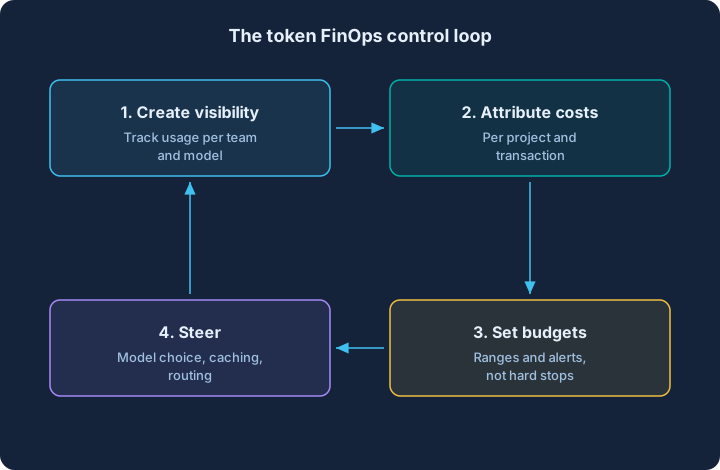
The control loop in four steps
-
Create visibility
Track consumption per vendor, team, user, and model daily, via the vendors' admin APIs or a dashboard tool. Shadow subscriptions in the departments belong on the list too.
-
Attribute costs
Report AI costs per project and transaction instead of one catch-all line item in the IT cost center. Only the cost per use case shows where AI pays off and where it does not.
-
Plan budgets with ranges
Point forecasts fail with AI. Set ranges of plus or minus 40 percent and configure threshold alerts instead of hard stops, so teams can react before the budget breaks.
-
Steer instead of blocking
Use cheaper models for simple tasks, evaluate caching and routing, and tie the cost per use case to business results. With a 300x cost variance between models, model choice is the biggest lever.

Anchor it organizationally: a monthly committee of finance, IT, and business owners that jointly manages budgets, model choice, and value evidence. And keep the governance side in view. Every AI agent that consumes tokens in your company also needs a controlled identity and clear permissions. How the two connect is covered in the piece on non-human identities for AI agents.
Further reading
Frequently asked questions
Token FinOps applies the FinOps discipline of cloud cost governance to AI spending. Its core is a control loop of four steps: make consumption visible per vendor, team, and model, attribute costs to projects and transactions, set budgets with ranges and alerts, and steer model choice continuously. In 2026, 98 percent of FinOps practitioners are responsible for AI spend, up from 31 percent in 2024.
Because consumption grows faster than prices fall. The price per token dropped 67 percent between early 2025 and early 2026, but agentic systems multiply the number of requests: Meta reports a 30-fold growth within six months. AI spending also spreads across the whole organization, not just IT. Mature FinOps teams that forecast cloud costs within 1 to 3 percent miss AI costs by a factor of two to three. According to the FinOps Foundation, 73 percent of companies were over plan.
1Password introduced AI Spend and Consumption Management as part of its SaaS Manager. The tool pulls consumption data from Anthropic, OpenAI, and Cursor daily via admin APIs, normalizes it into a single dashboard, and supports per-vendor budgets, threshold alerts via Slack and email, and breakdowns by team, user, API key, and model. It runs as a public preview, with general availability planned for fall 2026.
The Tokenomics Foundation was launched by the Linux Foundation on 9 June 2026 at the FinOps X conference. Together with the FinOps Foundation, it develops standards for measuring token consumption, handling price changes, and demonstrating the business value of AI spending. Participants include enterprises with high token consumption, hyperscalers, and model providers.
The first step is visibility, not austerity. Start by tracking consumption per vendor, team, user, and model, then attribute costs to projects and transactions instead of one catch-all AI line item. Plan budgets with ranges of plus or minus 40 percent and set threshold alerts rather than hard stops. Then steer continuously: cheaper models for simple tasks, caching and routing, and tie the cost per use case to business value.
Let's collaborate
One contact, a team behind it
Thirty minutes on what you're working on, whether grid, metering, market processes, IT architecture or AI. Afterwards you'll know how we'd approach it and who would sit at the table.
Energy and measurement technology since 2010 · innobu GmbH since 2014 · Based in Schleswig-Holstein, Germany
Whoever pitches also delivers: whoever leads the first call stays your contact right through to the steering committee, with established partners in the project. Direct: info@innobu.com