
Aleph Alpha and Cohere: Germany's AI Hope Goes Transatlantic
Aleph Alpha was long seen as Germany's answer to OpenAI. With its combination with Canadian provider Cohere at a valuation of around 20 billion dollars, co-funded by the Schwarz Group and backed politically by Berlin and Ottawa, the question of German AI sovereignty shifts from aspiration to reality. For you as a decision-maker, it helps determine whether you will have a serious non-American option for enterprise and public-sector AI.
The Canadian enterprise AI provider Cohere and Germany's Aleph Alpha are combining into a company valued at around 20 billion dollars, operating under the Cohere name with a dual headquarters in Toronto and Heidelberg. The ownership split is clear: Cohere shareholders hold about 90 percent, former Aleph Alpha shareholders about 10 percent, effectively an acquisition dressed as a merger. The Schwarz Group, parent of Lidl and Kaufland, leads Cohere's Series E round with around 600 million dollars and supplies the European cloud via STACKIT. Germany and Canada back the deal politically through the Sovereign Technology Alliance of February 2026, and Berlin is weighing a direct stake. Aleph Alpha had already abandoned its own frontier models in 2024 and now focuses, through its PhariaAI platform, on public agencies and regulated industries. For companies, what counts in the end is not the sovereignty label but whether the provider delivers on data location, contract, model quality and exit options.
Germany's AI hope goes transatlantic
Aleph Alpha, long treated as Germany's answer to OpenAI, is combining with Canadian provider Cohere. The combined company is valued at around 20 billion dollars, operates under the Cohere name and keeps a dual headquarters in Toronto and Heidelberg. For you as a decision-maker this is more than a startup headline, because it helps determine whether you will have a serious non-American option for enterprise and public-sector AI.
The move reflects a trend: mid-sized AI providers are pooling resources to stand up to the compute and capital power of Silicon Valley. How Europe is trying to build its own champions is covered by innobu in the piece on SPRIND and the bet on European AI labs.
How the deal is structured
Behind the merger language sits a clear balance of power. Cohere shareholders hold about 90 percent of the new company, former Aleph Alpha owners about 10 percent. The Schwarz Group is not investing in a continuation of Aleph Alpha but in Cohere's Series E round, a clear signal of where confidence has shifted.
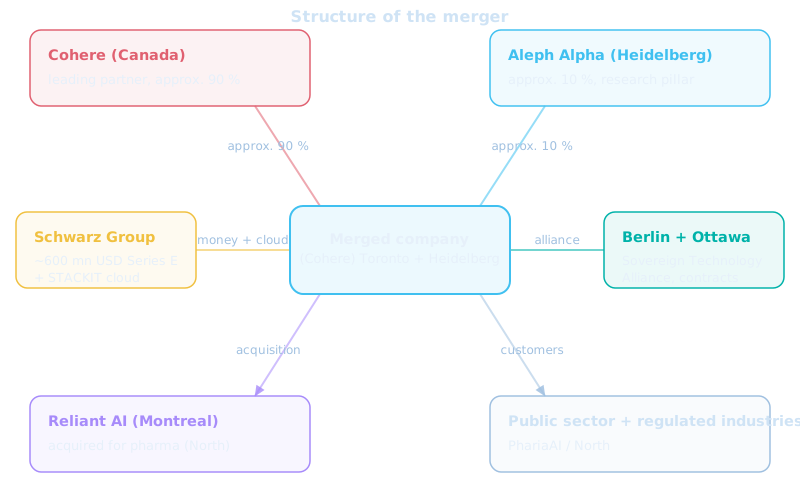
Cohere CEO Aidan Gomez describes the combination as complementary: Aleph Alpha's strengths in smaller language models, European languages and specialized tokenizers complement Cohere's broad enterprise platform, North. Aleph Alpha founder Jonas Andrulis stays on with research as a central pillar, while earlier investor Bosch had withdrawn in early 2026. In parallel, Cohere is acquiring the Montreal-based company Reliant AI to expand the North platform for the pharmaceutical industry.
German and EU perspective
The deal is politically intended. Its basis is the Sovereign Technology Alliance, a bilateral agreement between Germany and Canada from February 2026 meant to deepen AI cooperation between two G7 states. The German government sees it as a building block against dependence on US providers and ties it to concrete state contracts.

Federal Digital Minister Karsten Wildberger and his Canadian counterpart Evan Solomon carry the agreement, and Berlin is weighing a direct stake in the merged company. The PhariaAI platform targets public agencies and regulated industries, and the Pharia Government Assistant already runs in several federal ministries and at the Bundeswehr. Sovereignty here is defined through data control and infrastructure: European cloud, inspectable models, independence from US legal reach.
This sits within a broader German strategy: the federal government wants to at least quadruple AI compute capacity by 2030 and is funding an AI gigafactory with 805 million euros. The deal is therefore not a one-off but part of a state-driven catch-up effort.
How differently European countries are moving here is shown by innobu in the comparison digital sovereignty: France acts, Germany hesitates, and how sovereign AI lands in the public sector in the piece on sovereign AI for the public sector.
The bigger picture: the rise of AI middle powers
Observers read the combination as an example of the rise of AI middle powers. The term means advanced economies beyond the US and China that want to build their own sovereign AI. Canada, France, Germany, Japan, South Korea, Israel and the United Arab Emirates are among them.
Cohere
Canadian enterprise provider, now leading the new group.
Aleph Alpha
Heidelberg specialist for European languages and public agencies.
Mistral AI
French provider of open models with its own platform.
Sakana AI
Japanese lab focused on resource-light models.
AI21 Labs
Israeli provider of language models for enterprises.
G42
AI group from the Emirates with its own infrastructure.
Middle powers must clear three hurdles at once: find a competitive niche, secure access to compute, and build their own defensive capabilities.
Paraphrased from Anton Leicht, Carnegie, 2026Pooling resources across borders is an attempt to clear these hurdles together. Whether that turns into real market power or only a second-tier market is open. With DeepL and Black Forest Labs, Germany has further providers in the race, as the piece on Black Forest Labs as a German visual-AI champion shows.
Challenges and risks
The critical reading is plain: if Cohere owners hold 90 percent and the most important German money flows into the Canadian round, sovereignty is mostly a narrative frame. Aleph Alpha had already given up its original promise of being a German OpenAI when it exited frontier model development.
The real risk to sovereignty: A dependent home market does not replace global competition. Critics speak of industrial policy in reaction mode, because European venture capital and compute infrastructure still lag the US. The label sovereign does not replace the check of who ultimately controls data and roadmap.
What companies should do now
What matters for you is not the political symbolism but whether the provider delivers. Assess the German-Canadian provider like any other, by data location, contract terms, model quality and exit options, not by the sovereignty label.

-
Clarify data location
Establish exactly where data is processed and stored and which legal regimes apply, rather than relying on the word sovereign. Have the cloud region and legal basis confirmed in writing.
-
Avoid lock-in
Watch for open interfaces, the exportability of your data and the option to switch models. A new provider must not become the new dependency.
-
Evaluate by fit
Assess providers by fit for your use case, not by country of origin. A second, independent option remains sensible even when a provider is marketed as European.
-
Keep an eye on politics
Track the state stake and contract pipeline, because they can shape the roadmap and pricing. Set contract terms so you can react to changes.
The merger can create a serious non-American option, but it does not replace your own checks. Clarifying data location, contract and exit options and keeping a second option ready lets you use the benefits without creating a new dependency.
Further reading
Frequently asked questions
Germany's Aleph Alpha is combining with the Canadian enterprise AI provider Cohere. The combined company is valued at around 20 billion dollars, operates under the Cohere name and keeps a dual headquarters in Toronto and Heidelberg. The stated goal is an alternative to the dominant US providers for businesses and governments.
Cohere shareholders receive about 90 percent of the combined company, while former Aleph Alpha shareholders hold about 10 percent, effectively an acquisition dressed as a merger. The Schwarz Group leads Cohere's Series E round with around 600 million dollars and supplies the European cloud infrastructure through STACKIT.
Germany and Canada back the deal through the Sovereign Technology Alliance signed in February 2026. Federal Digital Minister Karsten Wildberger calls the merger a strong signal, and the government is weighing a direct stake while offering state contracts for the digitalization of public agencies.
That is contested. Supporters see a transatlantic champion with European cloud and inspectable models. Critics call it the quiet sale of Germany's AI hope, because control sits mostly outside Germany and European data-protection ambitions now depend on the decisions of a foreign-controlled company.
Assess the German-Canadian provider like any other, by data location, contract terms, model quality and exit options, not by the sovereignty label. Watch for open interfaces and data exportability to avoid a new lock-in, and keep a second, independent option available.
Let's collaborate
One contact, a team behind it
Thirty minutes on what you're working on, whether grid, metering, market processes, IT architecture or AI. Afterwards you'll know how we'd approach it and who would sit at the table.
Energy and measurement technology since 2010 · innobu GmbH since 2014 · Based in Schleswig-Holstein, Germany
Whoever pitches also delivers: whoever leads the first call stays your contact right through to the steering committee, with established partners in the project. Direct: info@innobu.com