The EU roadmap for digitalisation and AI in the energy sector
This article works through the roadmap in detail: what the EU decided on 3 June 2026, the three pillars it rests on, what AI.grids and the funding cover, how the EU ambition meets the German smart-meter reality and legal framework, how BDEW and VKU read the roadmap, what it means in practice for German municipal utilities, examined through Stadtwerke Flensburg, which challenges remain, and what companies should do now. The EU AI Act and German metering law are separate topics and are referenced here only where they connect.
On 3 June 2026 the European Commission presented its Strategic Roadmap for Digitalisation and Artificial Intelligence in the energy sector (COM(2026) 501), part of the European technological sovereignty package alongside the Chips Act 2.0, the Cloud and AI Development Act and an open-source strategy. The roadmap rests on three pillars: pillar 1 "Energy for AI" sustainably integrates data centres into the energy system through tripartite agreements, pillar 2 "Digitalisation and AI for the energy system" accelerates digital and AI solutions including the smart-meter rollout, pillar 3 "Data for AI and the energy system" creates a framework for cross-border data sharing through the Common European Energy Data Space. A cross-cutting block of trust in AI, cybersecurity, digital skills and international cooperation carries all three pillars, and ten actions make them concrete. The AI.grids flagship is building a first European AI foundation model for grid operation, carried by a 48-partner consortium coordinated by CRESYM; 14 industry associations signed a declaration of intent. The Commission puts the possible saving from demand-side flexibility at more than 71 billion euros per year for consumers and at up to 94 billion euros annually by 2035 from AI-based operation and maintenance optimisation; the 2026 to 2027 Horizon Europe work programme provides around 100 million euros for smart grids, 75 million euros for AI energy applications and 190 million euros for further digital solutions. The built-in tension remains: AI should make the system more efficient, yet the electricity consumption of data centres rises from 415 terawatt-hours in 2024 to around 945 terawatt-hours by 2030 according to the IEA. In Germany the EU ambition meets a slow smart-meter rollout that reached only 23.3 percent of mandatory cases and 5.5 percent of all metering points by the end of 2025. Most of this work falls to the municipal utilities as default metering point operators, which is why the roadmap concerns them above all, as the example of Stadtwerke Flensburg shows. For companies this means: map projects to the pillars, check funding eligibility, improve data quality and interoperability, prioritise AI use cases with clear benefit, and build cybersecurity and AI governance in early.
What the EU decided on 3 June 2026
On 3 June 2026 the European Commission presented its first dedicated roadmap for digitalisation and artificial intelligence in the energy sector. The document carries the number COM(2026) 501 and belongs to the European technological sovereignty package. It is not a law but a direction-setting decision: it brings together, for the first time, how AI and digital tools should make the European energy system more efficient, more secure and more independent, and it backs that ambition with funding, ten concrete actions and announced legal acts.
The roadmap sits inside a larger sovereignty agenda. Commission President Ursula von der Leyen frames the package by arguing that Europe must not depend on others for the technologies that secure its hospitals, energy networks and public services. Besides the roadmap, the package contains the Chips Act 2.0, the Cloud and AI Development Act (CADA, COM(2026) 502) and an open-source strategy. The energy part is led by Energy Commissioner Dan Jørgensen, who chaired the signature event. There, 14 industry associations from energy and data centres signed a declaration of intent on the sustainable integration of data centres into the energy system, and six companies signed an accompanying declaration of support.
Digitalisation and AI open new opportunities but also new challenges. If we want to secure Europe's digital sovereignty, we need to use its energy responsibly. We need to find a European balance.
Dan Jørgensen, EU Commissioner for Energy and Housing, on presenting the roadmap on 3 June 2026In substance the roadmap pursues two goals that stand in tension. On one side, AI should help to operate electricity grids better, run buildings more efficiently and unlock flexibility on the demand side. On the other, this very digitalisation, above all the build-out of data centres, drives energy consumption up. Data centres already account for around 2.5 percent of EU electricity consumption, and the figure is rising. The roadmap aims to reconcile the two rather than push only one. Concretely, it announces a legislative proposal for 2026 to accelerate the smart-meter rollout across the EU.
The roadmap does not come out of nowhere. It continues a line that began with the 2022 action plan on digitalising the energy system (COM(2022) 552) and was carried on by the 2023 action plan for grids (COM(2023) 757). The latter put the investment need in Europe's grids by 2030 at around 584 billion euros, most of it at the distribution level, exactly where municipal utilities operate. The timeline below places the roadmap in that sequence.
Action plan for digitalising the energy system
With COM(2022) 552 the Commission set out 24 measures, including building a common European energy data space.
Action plan for grids
COM(2023) 757 names the grids as the missing link of the energy transition and puts the investment need at around 584 billion euros by 2030.
Network code on electricity cybersecurity
Delegated Regulation (EU) 2024/1366 creates the first sector-specific EU cyber rules for cross-border electricity flows.
Roadmap for digitalisation and AI in energy
COM(2026) 501 brings the strands together for the first time in a dedicated strategy with three pillars, the AI.grids flagship and a smart-meter legislative proposal for 2026.
For companies this is more than Brussels symbolism. The roadmap sets the frame in which funding, coming obligations and AI applications will move over the next years. Anyone already wrestling with the EU AI Act will find the regulatory context in our article on AI regulation for energy utilities; the roadmap adds the strategic layer above it.
The three pillars of the roadmap
The roadmap orders its measures into three pillars that interlock: no AI without data, no flexibility without grid digitalisation, no secure data-centre integration without stable grids. For companies it pays to map their own projects to one of these pillars, because funding eligibility and coming obligations follow that structure.
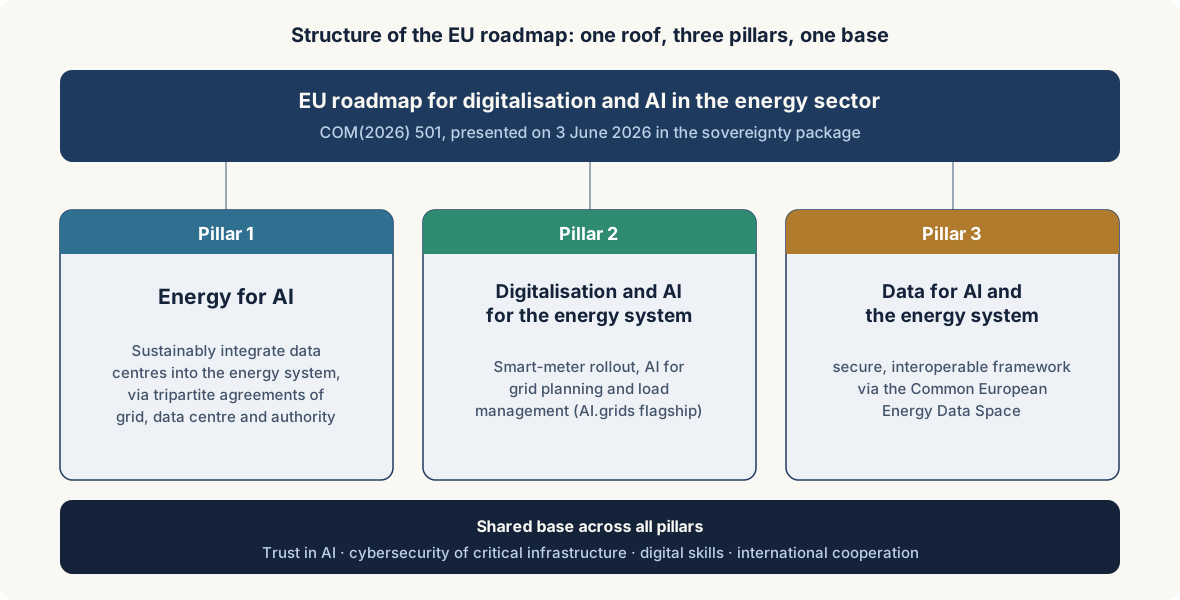
The first pillar is titled "Energy for AI". It concerns data centres, whose growing electricity demand should not run against the energy system but be embedded into it, through tripartite agreements between public authorities, data-centre operators and energy parties. The Commission plans to publish a model agreement in the second half of 2026. The aim is sustainable and transparent methods of siting and grid connection, so that new build strengthens rather than strains the grids. SolarPower Europe points to combinations of solar power and battery storage as a practical route here.
The second pillar, "Digitalisation and AI for the energy system", accelerates digital and AI solutions. This includes the smart-meter rollout, grid-enhancing technologies and the use of AI for grid planning, load forecasting and load management. The AI.grids flagship sits here, developing a shared AI model for grid operation. This pillar also holds the smart-meter legislative proposal announced for 2026.
The third pillar, "Data for AI and the energy system", creates the framework for data sharing. Its concrete vehicle is the Common European Energy Data Space, made up of an Energy Data Hub and an Energy Data Lab, which the Commission wants to build by the first quarter of 2027. This is meant to let metering and grid data be shared securely and interoperably across borders, for which verifiable digital identities in the energy system provide the basis of trust. Above all three pillars sits a shared block of trust in AI, cybersecurity of critical infrastructure, digital skills and international cooperation. In total, ten actions make the roadmap concrete.
| Pillar | Core EU instrument | Anchor point in Germany | What it means for utilities and municipal utilities |
|---|---|---|---|
| 1 Energy for AI | Tripartite agreements, model contract from mid 2026 | Data-centre grid connection, grid fees, siting | Steer connection requests, make waste heat and flexibility usable |
| 2 Digitalisation and AI | Smart-meter proposal 2026, AI.grids, Horizon funding | Metering law (MsbG), GNDEW, §14a and §41a EnWG | Accelerate the rollout, introduce AI for forecasting and planning |
| 3 Data for AI | Common European Energy Data Space by Q1 2027 | Market communication, redispatch 2.0, Data Act | Secure data quality and interoperability of metering and grid data |
| Base | Trust, cybersecurity, skills, cooperation | EU AI Act, cybersecurity network code (EU) 2024/1366 | Build AI governance and cybersecurity in from the start |
AI.grids and the funding
AI.grids is the most visible flagship of the roadmap. It launched on 3 June 2026 with a project agreement and is building a first European AI foundation model for grid operation, trained on diverse European grid data. It is carried by a 48-partner consortium coordinated by the research organisation CRESYM, including the transmission association ENTSO-E, the EU DSO Entity, several transmission and distribution system operators, research institutes and companies. The idea behind it is pooling: instead of every grid operator developing models on its own, grid operators, research and industry pull together.
The roadmap is backed by concrete sums from the 2026 to 2027 Horizon Europe work programme. Around 100 million euros go to advanced smart-grid solutions, 75 million euros to AI energy applications and 190 million euros to digital solutions around renewables, smart buildings and energy efficiency, roughly 365 million euros in total. AI.grids itself has dedicated calls of around 30 million euros in 2026 and 20 million euros in 2027. This is not a vast pot, but a clear signal of where European research and innovation funding in energy is being steered.
The Commission supplies the economic frame as well. It puts the possible saving from demand-side flexibility at more than 71 billion euros per year for consumers, around a sixth of their electricity costs, and the saving from AI-based operation and maintenance optimisation at up to 94 billion euros annually by 2035. On top of that comes a wider system benefit the Commission estimates at more than 300 billion euros. These figures are potential estimates, not guarantees, but they show the scale the Commission attaches to the topic.
The investment need on the supply side is governed not by the roadmap itself but by the accompanying Cloud and AI Development Act (CADA, COM(2026) 502). It aims to at least triple the EU's data-centre capacity within five to seven years and cites an investment need in the order of 200 billion euros. So anyone reading about large sums for European cloud and AI infrastructure should attribute them to CADA, not to the energy roadmap.
AI.grids is the concrete connection point for grid operators. Those who hold good-quality metering and grid data and engage early help shape the shared AI model rather than merely adopting it later. That explicitly includes municipal distribution system operators.
Germany: the smart-meter reality and legal framework
For Germany the roadmap meets a sobering reality. Of all things, the smart-meter rollout that the EU wants to accelerate is moving only slowly there. Germany is a good example of the gap between EU ambition and national delivery that the roadmap is meant to close.

The targets have been clear for years. The EU Electricity Directive 2019/944 requires at least 80 percent smart-meter penetration by 2024, where cost-effective. Around half of the 27 member states have completed their national rollout, with Italy, Finland, France and the Netherlands ahead. Germany is among the laggards. The often-quoted figure of around one percent, however, comes from an EU comparison for 2023 and 2024 and is outdated: according to the Bundesnetzagentur, some 3.1 million smart metering systems were installed by 31 December 2025, which is 5.5 percent of all 56.5 million metering points. Among the mandatory cases the quota stood at 23.3 percent. So the rollout is still slow, but no longer in the per-mille range.
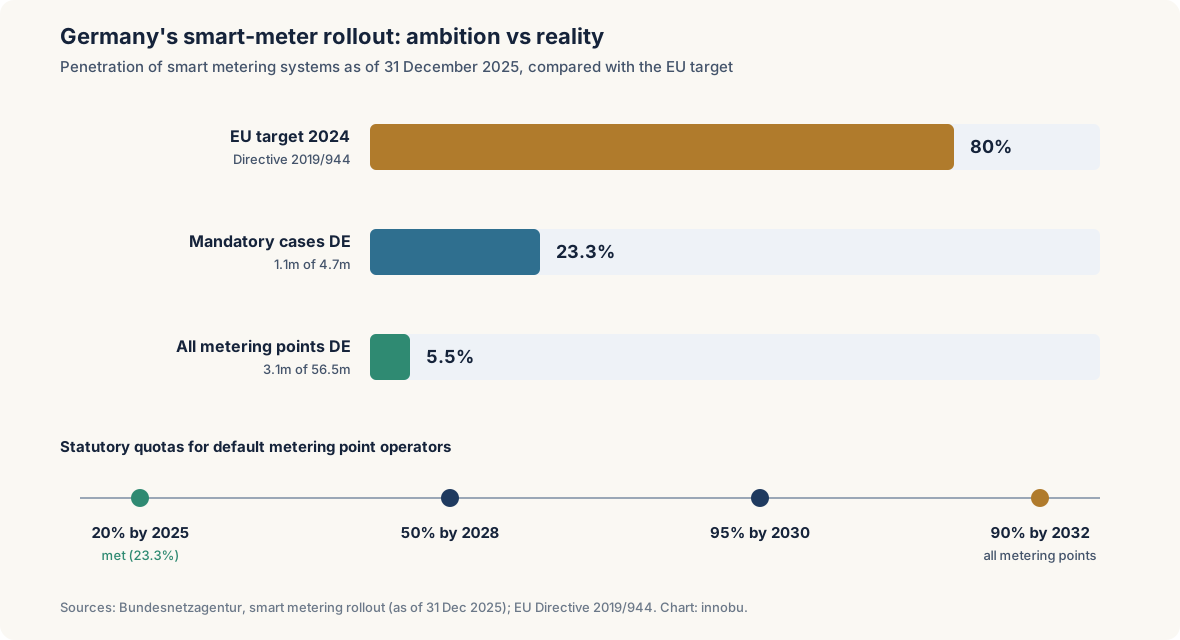
The frame is set by the Metering Point Operation Act (MsbG), amended in 2023 by the Act on the Restart of the Digitalisation of the Energy Transition (GNDEW). It introduced the agile rollout, in which devices no longer have to meet all requirements at once, and set statutory quotas: at least 20 percent of mandatory cases by the end of 2025, 50 percent by 2028 and 95 percent by 2030; the Bundesnetzagentur's overall target is 90 percent of all metering points by the end of 2032. Smart metering systems are mandatory above an annual consumption of 6,000 kilowatt-hours, for controllable loads under §14a EnWG, and for generation plants above 7 kilowatts; for households the metering charge is capped at 20 euros a year.
One reason for the long delay lay in certification: only since February 2024 have there been five independent manufacturers with fully certified smart-meter gateways, vetted by the Federal Office for Information Security to the technical guideline TR-03109. The pace is now picking up, but the Bundesnetzagentur is not satisfied: at the end of March 2026 it opened 77 proceedings against metering operators that had not even started the rollout. Digitalising the grids with smart metering systems, the authority said, is a decisive building block of the energy transition.
The metering systems are not an end in themselves. Since January 2024 controllable loads such as heat pumps and wallboxes have had to be grid-controllable under §14a EnWG, and since January 2025 all electricity suppliers have had to offer dynamic tariffs under §41a EnWG, but only for customers with a smart metering system. Both therefore depend directly on the rollout. This is exactly where the announced EU smart-meter legislative proposal for 2026 comes in. For German providers that means double pressure: national delivery is ramping up slowly while the European level raises the pace. Anyone who wants to go deeper into the backlog and its causes will find it in our analysis of the stalling smart-meter rollout. Without broad metering data, much of what the roadmap promises in AI applications will, for now, stay theory in Germany.
What BDEW, VKU and the industry say
In Germany the roadmap meets an industry that already has the topic firmly on its agenda. The Federal Association of the Energy and Water Industry (BDEW), which represents more than 2,000 companies, calls digitalisation the key to mastering the rising complexity of the energy system. Its Digital@EVU study 2026 shows how far the topic has come: more than 90 percent of energy companies already work with an AI strategy or are planning one, and around a third have implemented it. The gap lies elsewhere. Only 29 percent have a personnel strategy for the skills they need.
Digitalisation and artificial intelligence are no longer niche topics.
Kerstin Andreae, Chair of the BDEW General Executive Management, on the Digital@EVU study 2026In the European debate the BDEW calls for innovation-friendly rather than restrictive rules. AI should be seen more as an opportunity and not slowed by excessive caution, the risk classification of the EU AI Act should be clarified quickly, and data governance simplified. This line aligns with the roadmap, which describes trust in AI and simple data rules as a foundation. A specific BDEW reaction to the finished document of 3 June 2026 was not available at the time of writing; the positions cited here are the association's standing positions.
From the municipal angle, the Association of Local Utilities (VKU), which represents around 1,600 municipal companies, weighs in. Their members hold high market shares, around 66 percent in electricity supply, 65 percent in gas and 91 percent in heat. As early as November 2025 the VKU set out a position paper on the Commission's consultation, stressing that the timely, ideally real-time transmission of metering data is the precondition for flexible and dynamic tariffs. In Germany these data streams come predominantly from municipal utilities.
Behind the roadmap stands a dense legal framework that utilities have to keep in view. The EU AI Act classifies AI that operates critical infrastructure such as the supply of electricity, gas or heat as a safety component, and therefore as high-risk. With the so-called Digital Omnibus, Council and Parliament agreed in May 2026 to postpone the obligations for such high-risk applications, from August 2026 to December 2027; the postponement is not yet finally adopted. Added to that are the Data Act, applicable since September 2025, and the cybersecurity network code (EU) 2024/1366, the first sector-specific EU cyber rulebook for electricity, while the BSI has separately put post-quantum cryptography on a 2030 deadline. Anyone planning AI in grid operation should consider these three legal acts together.
What the roadmap means for German municipal utilities
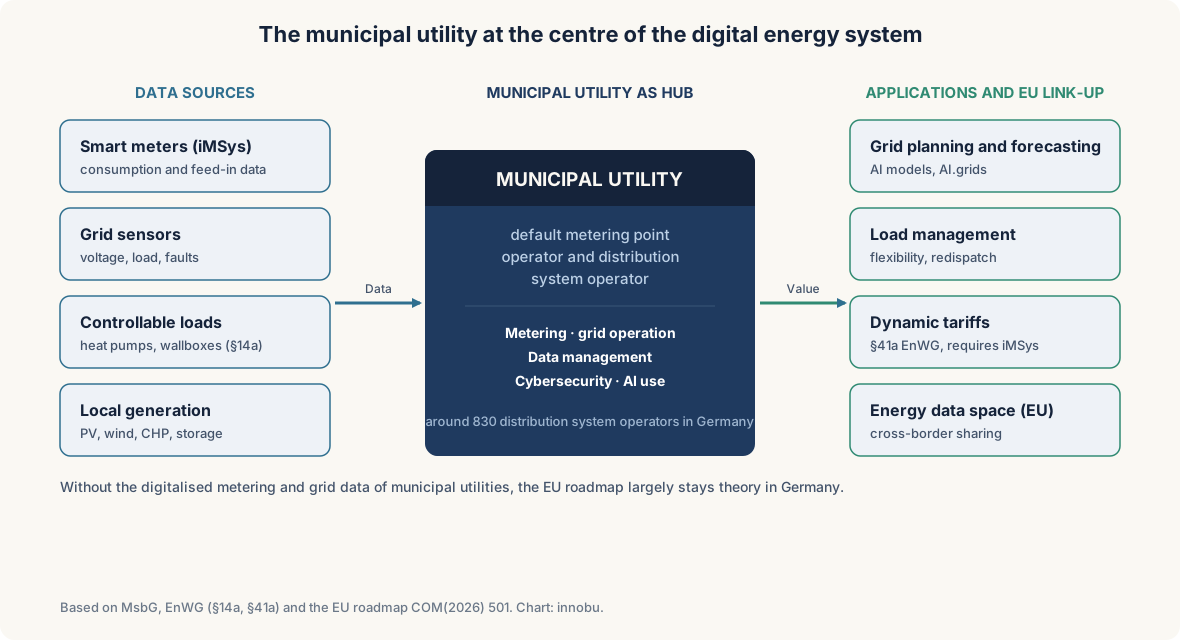
No other actor is as directly affected by the roadmap as the municipal utilities, the Stadtwerke. In Germany around 2,300 companies are active in electricity, gas and district heating, among them roughly 830 electricity distribution system operators. The large majority of these distribution grids are municipal or regional, not in the hands of the four big transmission system operators. So the practical delivery of what the roadmap sets in motion at European level rests to a large extent with the municipal utilities on the ground.
This is clear already in the smart-meter rollout. The default metering point operator is, as a rule, the local grid operator, often a municipal utility. It has to install, operate and secure the smart metering systems and meet the statutory quotas. Municipal utilities are thus the hub of the digital energy system: the data from smart meters, grid sensors, controllable loads and local generation come together at them, and whether this turns into applications such as load forecasting, redispatch, dynamic tariffs and the European energy data space depends on them.
This central role is also a burden. The VKU considers the smart-meter rollout under the current price cap economically unviable for default metering point operators and calls for improvements. The BDEW municipal utility study 2025 paints a tense picture: 86 percent of the utilities surveyed rate the regulatory requirements as rather to very negative, only 48 percent consider their business success good or very good, the lowest value since 2005. Regulation and bureaucracy, the study concludes, tie up valuable transformation resources. The roadmap tends to sharpen this demand rather than ease it.
At the same time there is an opportunity, and some municipal utilities are already taking it. The examples below show what AI looks like concretely in the municipal energy business.
AI and a digital twin optimise district heating. A pilot with Fraunhofer ITWM cut primary energy use by around 10 percent and is being scaled from 8 to more than 120 plants from 2025.
The AI tool elenova plan shortens the planning of generation plants from 480 to 30 minutes and makes variants comparable faster.
AI controls district-heating and geothermal networks, and the M/Partnerkraft virtual power plant bundles distributed units from 100 kilowatts into marketable flexibility.
An AI heat-load forecast over 24 hours cuts the deviation against the conventional method by around 25 percent and features in the dena district-heating guide.
Municipal utilities also join forces. At the VKU municipal utility award 2025 the GenAI Factory for grid operators won, in which seven grid operators jointly develop generative AI for electricity load forecasts, customer service, grid documentation and the automatic handling of incoming cases. On a small scale, that is exactly the pooling AI.grids aims for at European level. On the customer side, this ties into AI customer service and churn prevention at utilities.
Three levers count: first, take the smart-meter rollout and data quality seriously as a mandatory task; second, prioritise AI use cases with clear benefit such as load forecasting and grid planning; third, build skills and cybersecurity rather than buy them in. Those too small to act alone cooperate, through municipal utility alliances, shared service providers or initiatives such as AI.grids.
Case study: Stadtwerke Flensburg
What the roadmap looks like in practice can be shown well at Stadtwerke Flensburg, the energy utility in our home region. Founded in 1854, the company is wholly owned by the city of Flensburg, employs around 711 people (as of 2023) and supplies more than 200,000 customers with electricity, district heating, drinking water, industrial gas and telecommunications. It is therefore a typical and at the same time special municipal utility: typical in its municipal ownership, special in its heat and its location on the border with Denmark.
Flensburg has the highest district-heating share of any German city. Around 98 percent of households are connected to the district-heating network, which spans more than 700 kilometres and has been fed by combined heat and power since 1969. At its heart is the combined-cycle heating plant Kessel 12, which came online in 2016 for around 128 million euros and generates electricity and heat together at about 92 percent efficiency. This tight coupling of electricity and heat is exactly the sector coupling the EU roadmap wants to make more efficient through digital control.
In November 2023 the company presented its transformation plan, with the clear goal of becoming climate-neutral by 2035. Around half a billion euros will flow into the conversion by then, with the coal exit starting from 2030. Some 250 million euros have already been invested to convert four of five coal boilers to combined-cycle technology, which cut CO2 emissions at the same capacity by about 40 percent. The path runs in four phases.
Power-to-heat and a first large heat pump
A second electrode boiler, a second heat store of around 28 million litres, a first large heat pump of 60 megawatts thermal from Förde seawater (commissioning 2027), plus a wastewater heat pump and solar thermal.
Second heat pump and hydrogen
A second Förde heat pump of around 60 megawatts, the co-firing of hydrogen up to 15 percent by volume in the heating plant, and a flow temperature lowered to 115 degrees.
Biomass and full hydrogen capability
A biomass boiler of 70 megawatts thermal, the ability to burn 100 percent hydrogen and a third, decentralised heat store. Heat generation at the plant is then fully decarbonised.
Reserve plants climate-neutral
The remaining reserve heating plants are converted to CO2-neutral operation.
Flensburg had examined geothermal energy together with the Danish developer Innargi, but the potential of the subsurface proved too small with today's technology. That is an important lesson: not every option holds, and a robust plan also names the routes it has dropped. Digitalisation, by contrast, is firmly planned. The company intends to digitalise its network further, optimise pumping stations automatically and make all district-heating meters remotely readable. There is no dedicated AI showcase project on the RheinEnergie model so far; the strength lies in digitalised grid and heat control and in the metering data foundation.
The strongest link to the roadmap, though, is the border location. Flensburg's electricity grid was historically not connected to the German transmission system operator TenneT, but to the Danish grid of Energinet at 60 and 150 kilovolts via a phase-shifting transformer. The transformation plan now foresees a new 110-kilovolt connection to the German grid, and a hydrogen pipeline to Denmark is planned. That makes Flensburg a concrete example of the cross-border integration of electricity, data and hydrogen that the roadmap wants to advance through its data space and its international cooperation.
Combined heat and power, Germany's highest district-heating share, sector coupling through power-to-heat, large heat pumps and storage, a digitalised grid control and a cross-border location on the Danish border: Stadtwerke Flensburg combine the core themes of the roadmap in a single municipal utility.
Challenges and risks
The roadmap carries a built-in conflict: AI should make the energy system more efficient, yet AI and its data centres drive electricity consumption up themselves. The roadmap does not resolve this tension, it makes it the programme. Added to that are questions of security and technological dependence.

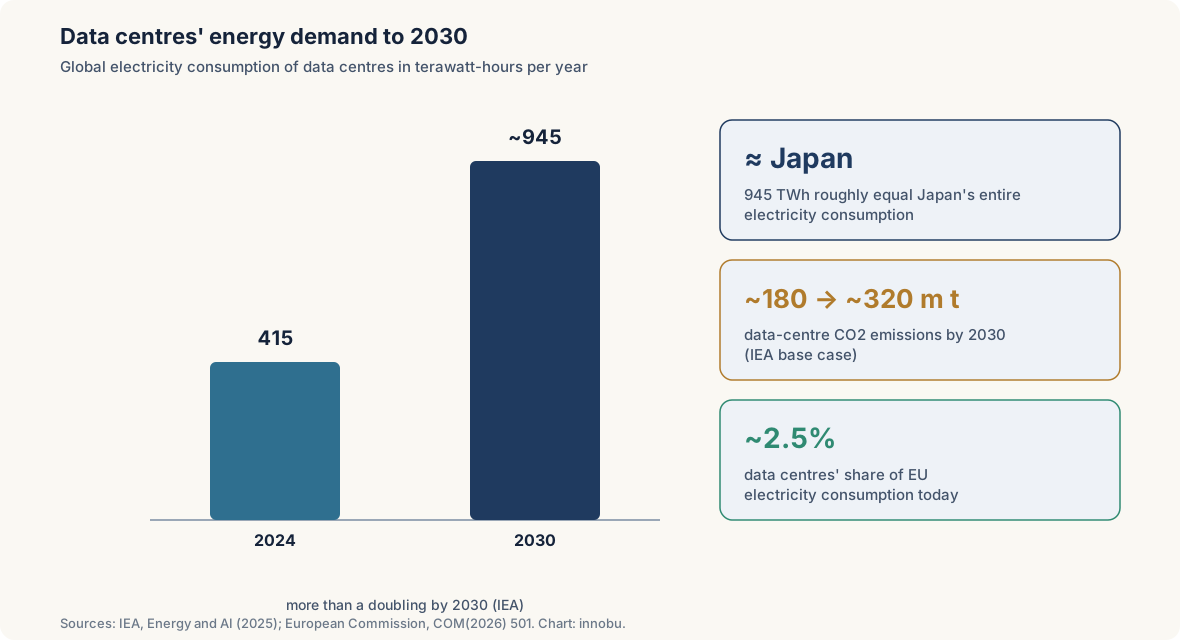
The numbers on energy demand are stark. According to the International Energy Agency, the global electricity consumption of data centres rises from 415 terawatt-hours in 2024 to around 945 terawatt-hours by 2030, more than a doubling and roughly equal to Japan's entire electricity consumption. Those 945 terawatt-hours cover all data centres; the share attributable specifically to AI is around 40 percent. The associated CO2 emissions rise in the IEA base case from about 180 to around 320 million tonnes by 2030. How this demand plays out on grids and siting is explored in our article on data-centre strategy and AI energy demand, and the grid-stability debate in the piece on the NERC alert on AI data centres.
More digitalisation also means more attack surface. SolarPower Europe stresses that the cybersecurity of critical energy infrastructure must remain central, because every additional interface and every connected device creates a new point of entry. The roadmap therefore treats cybersecurity as a cross-cutting theme, yet the concrete hardening remains the operators' job.
Finally, sovereignty stays an aspiration for now. Europe wants to build its own AI and cloud capacity but today depends heavily on US providers. The roadmap and the accompanying legislative proposals aim to change that, yet building European data centres, models and skills is a project over many years. Until then, the intended independence is more goal than state.
What companies and municipal utilities should do now
Energy providers and industrial customers should use the roadmap as a planning basis rather than wait. Anyone who orders their data foundation and grid digitalisation now is eligible for funding and ready to connect to AI.grids and coming legal acts. The first step is a sober mapping: which of your own projects belong to which of the three pillars, and which are eligible under the 2026 to 2027 work programme?
Mapping is followed by data work. Cross-border data sharing is becoming an obligation, so it pays to improve the data quality and interoperability of metering and grid data early. In parallel, companies should prioritise AI use cases with a clear benefit, such as load forecasting, AI-accelerated congestion analysis and predictive maintenance. Digital grid models and AI-supported scenario analysis help here, computing variants faster and more comparably than manual methods ever could.
Just as important is to build cybersecurity and AI governance in from the start rather than retrofit them later. Anyone using AI in grid operation needs clear rules on data provenance, model quality and accountability. Finally, companies should track the regulatory development actively, above all the announced smart-meter legislative proposal for 2026 and the chance to take part in AI.grids. That turns a Brussels direction-setting decision into a concrete roadmap for the individual organisation.
For municipal utilities there is an added twist: they carry the smart-meter rollout as a mandatory task and run into economic limits doing so. That makes pooling scarce resources all the more important. Smaller utilities do not have to build AI models, data platforms and security skills alone; they can join forces through municipal utility alliances, shared service providers, buy in prosumer platforms and white-label apps and initiatives such as AI.grids. The Flensburg example also shows that a robust plan honestly names which options do not work. Those who order their data foundation, sector coupling and cooperation now turn the roadmap into an advantage rather than another obligation.
Further reading
Frequently asked questions
The roadmap is a strategy document of the European Commission (COM(2026) 501) presented on 3 June 2026 as part of the technological sovereignty package. It describes how AI and digital tools should make the European energy system more efficient, more secure and more independent, without the energy demand of digital infrastructure overloading the system. The roadmap is not a law but a direction-setting decision backed by funding and announced legal acts, including a legislative proposal to accelerate the smart-meter rollout in 2026.
First, the sustainable integration of data centres into the energy system through tripartite agreements between grid operators, data centres and authorities. Second, the accelerated uptake of digital and AI solutions, including the smart-meter rollout and AI for grid planning and load management. Third, a framework for cross-border data sharing so that metering and grid data can be shared securely and interoperably. Cross-cutting themes are trust in AI, cybersecurity of critical infrastructure, digital skills and international cooperation.
AI.grids is the most visible flagship of the roadmap. It launched on 3 June 2026 with a project agreement and works as a community of practice on AI models for grid operation and grid planning, trained on European data. Rather than isolated projects, AI.grids brings grid operators, research and industry together to develop models jointly. It is backed by around 100 million euros for smart-grid solutions and 75 million euros for AI energy applications from the 2026 to 2027 work programme.
The 2026 to 2027 work programme provides around 100 million euros for advanced smart-grid solutions, 75 million euros for AI energy applications and 190 million euros for digital solutions around renewables, smart buildings and energy efficiency. In the wider sovereignty package the Commission puts the investment need for European cloud and AI data centres at around 200 billion euros by 2036. Companies should map their digital projects to the three pillars and check eligibility in the work programme.
The roadmap meets a slow smart-meter rollout in several member states, exactly what the EU now wants to accelerate. The EU Electricity Directive 2019/944 requires at least 80 percent smart-meter penetration by 2024; around half of member states have completed their rollout, while Germany is among the laggards. By the end of 2025 only 5.5 percent of all metering points and 23.3 percent of mandatory cases were equipped. Energy providers should use the roadmap as a planning basis: improve data quality and interoperability, prioritise AI use cases with clear benefit, and build cybersecurity and AI governance in early.
Municipal utilities are particularly affected because, as default metering point operators and distribution system operators, they put the smart-meter rollout and grid digitalisation into practice. Germany has around 830 electricity distribution system operators, the large majority municipal or regional. At the municipal utilities the data from smart meters, grid sensors and controllable loads come together, which the roadmap wants to use for AI applications. It is both burden and opportunity: the VKU considers the rollout economically unviable under the current price cap, while utilities such as RheinEnergie, Leipzig or SWM Munich already use AI in production.
Stadtwerke Flensburg combine the core themes of the roadmap in one municipal utility. They supply around 98 percent of the city with district heating from combined heat and power, the highest share of any German city. Their transformation plan targets climate neutrality by 2035, with power-to-heat, large heat pumps from Förde seawater, heat storage and hydrogen, exactly the sector coupling the roadmap wants to make more efficient. Added to that is the border location: the grid was historically connected to the Danish grid of Energinet, and a new connection to the German grid and a hydrogen pipeline to Denmark are planned. That is the cross-border integration the roadmap aims for.
Both associations support digitalisation but call for workable conditions. The BDEW calls digitalisation the key to mastering system complexity and argues for innovation-friendly rules and a swift clarification of the EU AI Act's risk classification. According to the BDEW Digital@EVU study 2026, more than 90 percent of energy companies already work with or plan an AI strategy, yet only 29 percent have a matching personnel strategy. The VKU stresses that timely metering data are the precondition for dynamic tariffs and calls for adequate funding of the rollout. A specific reaction to the finished document of 3 June 2026 was not yet available.