
ChatGPT Work and GPT-5.6: OpenAI's Work Agent
On 9 July 2026 OpenAI launched ChatGPT Work, an agent that turns a goal into finished deliverables. It gathers context from connected apps such as Drive, Slack and mail, breaks a project into steps and works for hours until spreadsheets, presentations, documents or web apps are ready. It is powered by the new GPT-5.6 model family with the tiers Sol, Terra and Luna; Sol leads the Coding Agent Index with 80 points. At the same time OpenAI folds the Codex app into a single ChatGPT desktop client, with the old interface staying as ChatGPT Classic. For European companies, an agent with broad data access shifts the risk from what an employee pasted to what the agent decided on its own. From 2 August 2026 the EU AI Act applies in full to high-risk systems, and GDPR requires tight access rights, approval steps and logging.
From chat to a result agent
On 9 July 2026 OpenAI introduced ChatGPT Work, an agent that turns a goal into finished work rather than just answering. It gathers context from connected apps, breaks a project into steps and works on it for hours. The ambition shifts from "help me with the text" to "deliver the result".
ChatGPT Work produces spreadsheets, presentations, documents and interactive web apps through the new Sites feature, which is in open beta. You can pull in apps with an @-mention, and ChatGPT suggests relevant plugins as the work unfolds. More than 1,400 plugins sit in one unified directory, and early testers connected HubSpot, Gong, email, Slack and project tools. The groundwork for apps inside ChatGPT was the Apps SDK, covered in our guide to OpenAI Dev Day 2025.
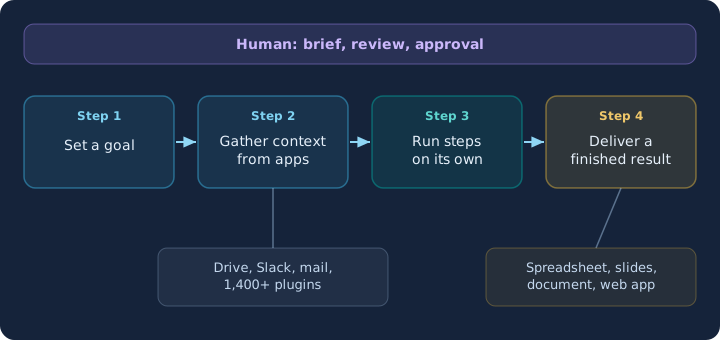
The difference from ordinary chat is not answer quality, it is autonomy. An agent that works for hours across your apps on its own needs different guardrails than a text assistant that waits for every input.
GPT-5.6 as the engine: Sol, Terra, Luna
The engine behind ChatGPT Work is the GPT-5.6 model family, launched the same day. It comes in three tiers that stagger price and performance. For agentic coding tasks the top variant Sol leads.
| Tier | Price per M tokens (input / output) | Where it fits |
|---|---|---|
| Sol | $5 / 30 | flagship, rank 1 in the Coding Agent Index (80), 91.9% on Terminal-Bench 2.1 |
| Terra | $2.50 / 15 | roughly GPT-5.5 level at half the price |
| Luna | $1 / 6 | cheapest tier for simple, high-volume tasks |
In the Artificial Analysis Intelligence Index, GPT-5.6 Sol scores 59 points, just behind Claude Fable 5 at 59.9, at roughly one third of the cost per task. In practice, the expensive tier pays off on demanding agentic runs, while Terra or Luna are enough for routine work. How to keep such costs in check is covered in the piece on token FinOps.
Codex becomes part of ChatGPT
OpenAI is tidying its product shelf. The standalone Codex app moves into a single, rebuilt ChatGPT desktop client. Anyone who wants the old interface will find it as ChatGPT Classic.
The step ends Codex as a separate product. On macOS the new client ships immediately, on Windows in stages. Billing is usage-based like an API, not a flat license fee. Longer tasks consume more of a plan's included usage, which is why a cost view per task pays off.
For teams that already used Codex as a desktop super-app, this is the next stage of consolidation. The starting point is described in the piece on the Codex super-app. What is new is that chat, coding and the work agent now run in one interface.
What it means for work
An agent that works for hours on its own changes how tasks are cut. Routine with a clear goal and a solid data basis can be delegated, and the human role shifts to brief, review and approval. That is both an opportunity and a risk.
A good fit
- Recurring reports and data preparation with a clear template.
- First drafts of presentations and documents that a human then sharpens.
- Simple internal web tools through the Sites feature.
Harder cases
- Tasks with no clear sign-off or with incomplete data.
- Decisions with a high cost of error, where one wrong step gets expensive.
A comparison with other result agents helps with the classification. How Anthropic approaches the same idea is shown in the piece on Claude Cowork.
European perspective
For European companies, data access is the crux. An agent that reaches into Drive, Slack and mail and acts on its own shifts the risk from "what did someone paste" to "what did the agent send on its own". The legal framework tightens in parallel.

From 2 August 2026 the EU AI Act applies in full to high-risk systems. Article 50 requires transparency when people interact with an AI system. GDPR adds to this: access to personal data needs a legal basis, a data processing agreement and purpose limitation. Over-permissioned SaaS accounts widen the attack surface, a problem the piece on non-human identities examines more closely.
That regulators watch ChatGPT closely is not theory. Italy's data protection authority Garante has repeatedly investigated the service and, in December 2024, imposed a fine of 15 million euros. An agent with access to company data raises the stakes.
Challenges and risks
The jump to a result agent brings concrete downsides. Three points belong in any assessment before a team rolls out ChatGPT Work widely.
Data leakage is the biggest risk. According to Metomic, 34.8 percent of ChatGPT inputs contain sensitive data, roughly three times the 2023 figure. An agent with broad access makes this worse, because it decides for itself which data to combine and send.
- Autonomy without control. Without approval steps and logging, the agent makes decisions that no one can trace. An hours-long run is hard to review after the fact.
- Cost. Usage-based billing makes long runs expensive. Without a budget per task, an unclear bill builds up fast, especially when the pricey Sol tier is in play.
- Dependence. Tying processes firmly to ChatGPT Work creates vendor lock-in. Keeping prompts, flows and interfaces vendor-neutral protects your ability to switch.
What companies should do now
ChatGPT Work is a reason for a controlled test, not for a blind start. Setting guardrails now captures the value without the usual mistakes.

Five priority steps
-
Start with non-critical tasks
First tests with clear sign-off criteria and without customer data. That is how you learn the strengths and limits before sensitive processes hang on it.
-
Limit access rights
Restrict the rights of connected apps to what is needed and clean up over-permissioned accounts. The agent should only see what the task requires.
-
Anchor approval and logging
An approval step for anything the agent sends outside, plus a log of every action. Without traceability the run cannot be audited.
-
Measure cost per task
Set a budget per task and pick the tier to match. Not every task needs Sol; for routine work Terra or Luna are enough.
-
Clarify AI Act and GDPR roles
Define who is responsible for the result and what transparency duty applies toward users. The documentation belongs at the start, not in the rework.
Further reading
Frequently asked questions
ChatGPT Work is an agent inside ChatGPT that OpenAI launched on 9 July 2026, powered by GPT-5.6 and Codex. It takes a goal, gathers context from connected apps, breaks a project into steps and works on it for hours until a finished result is ready. That includes spreadsheets, presentations, documents and interactive web apps built through the new Sites feature.
GPT-5.6 is the model family OpenAI launched on 9 July 2026 with three tiers: Sol, Terra and Luna. Sol costs 5 US dollars per million input tokens and 30 per million output tokens, Terra 2.50 and 15, Luna 1 and 6. According to Artificial Analysis, Sol leads the Coding Agent Index with 80 points and reaches 91.9 percent on Terminal-Bench 2.1.
OpenAI is folding the standalone Codex app into a single, rebuilt ChatGPT desktop client. The old interface remains available as ChatGPT Classic. On macOS the new client ships immediately, on Windows it rolls out in stages. Billing is usage-based like an API, not a flat license fee.
It is possible, but it takes care. An agent that reaches into Drive, Slack and mail processes personal data and needs a legal basis, a data processing agreement and purpose limitation. What matters is tightly scoped access rights, an approval step for anything the agent sends outside, and logging. From 2 August 2026 the EU AI Act also applies in full to high-risk systems, and Article 50 requires transparency toward users.
It suits recurring tasks with a clear goal and a solid data basis: reports, data preparation, first drafts of presentations and simple internal web tools. It struggles with tasks that have no clear sign-off, incomplete data or a high cost of error. The human stays responsible for the result, even when the agent handles most of the steps.
ChatGPT Work bills on usage, similar to an API workload, not as a flat license fee. Longer tasks consume more of a plan's included usage. At launch there were no published per-task prices. For planning that means measuring cost per task and setting a budget before long autonomous runs become routine.
Let's collaborate
One contact, a team behind it
Thirty minutes on what you're working on, whether grid, metering, market processes, IT architecture or AI. Afterwards you'll know how we'd approach it and who would sit at the table.
Energy and measurement technology since 2010 · innobu GmbH since 2014 · Based in Schleswig-Holstein, Germany
Whoever pitches also delivers: whoever leads the first call stays your contact right through to the steering committee, with established partners in the project. Direct: info@innobu.com