
GPT-Live: OpenAI's voice AI listens while it speaks
On 8 July 2026 OpenAI released GPT-Live-1 and GPT-Live-1 mini, replacing Advanced Voice Mode in ChatGPT worldwide. The models work full duplex: they listen while they speak and decide several times per second whether to answer, pause or invoke a tool. GPT-Live delegates complex tasks to GPT-5.5 in the background. On the GPQA knowledge benchmark, accuracy rises from 45.3 to 84.2 percent as a result, and on the agentic web search benchmark BrowseComp from 0.7 to 75.2 percent. An API is missing at launch. For companies in the EU, the launch coincides with the transparency obligation under Article 50 of the EU AI Act, which applies in full from 2 August 2026: anyone using voice AI in customer contact must disclose it as AI at the first interaction. Violations can trigger fines of up to 15 million euros or 3 percent of global annual turnover.
What OpenAI released
Since 8 July 2026, ChatGPT sounds different. OpenAI has rolled out two new voice models, GPT-Live-1 and GPT-Live-1 mini, replacing the previous Advanced Voice Mode. The difference is fundamental: the new models listen while they speak. You can cut in, ask for a shorter version or simply stay silent without the AI treating the pause as a prompt to talk.
The rollout runs globally on iOS, Android and chatgpt.com. GPT-Live-1 mini becomes the default for all users, including the free tier. The larger GPT-Live-1 remains reserved for the Go, Plus and Pro subscription tiers.
- Nine predefined voices are available. Imitation of real voices is technically blocked.
- Documented conversations run for 30 to 40 minutes at a stretch, with small acknowledgements like "mhm" while you speak.
- There is no API at launch. OpenAI says "soon" and collects interested developers via a form.
GPT-Live is not a feature update but an architecture change. The rigid turn-taking between human and machine that has shaped voice assistants since Alexa and Siri is gone.
Full duplex: how the new architecture works
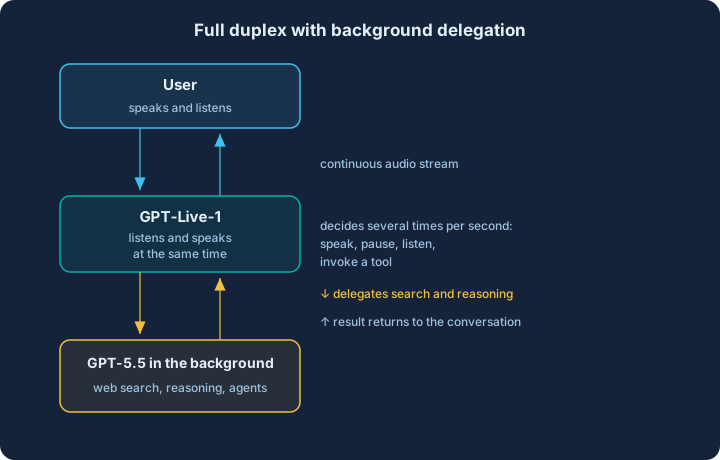
Full duplex means the model processes incoming audio and generates output at the same time. It decides several times per second whether to speak, pause, interrupt or invoke a tool. Previous voice assistants could only ever do one of the two.
Getting here took three generations. Each solved one problem and left another open.
ChatGPT Voice: the cascade
Three separate steps: speech recognition, text model, speech synthesis. Functional, but with noticeable latency and no sense of tone or irony.
Advanced Voice Mode: one audio model
A single model processes audio directly, with around 320 milliseconds of response latency. The principle stayed turn-based though: listen first, then speak.
GPT-Live: full duplex
Listening and speaking run in parallel. The model handles silence and background noise far better and stays quiet while you think.
One point matters for developers: the Realtime API used to build call centre bots and phone assistants today is separate from this. Despite reduced latency it remains turn-based. Full duplex stays exclusive to ChatGPT for now.
Delegation to GPT-5.5: the benchmarks
GPT-Live is deliberately not a frontier model but a conversation model with access to one. When a question needs web search, deeper thinking or agentic capabilities, GPT-Live delegates the task to GPT-5.5 in the background and feeds the result back into the running conversation. All you notice is that the answer arrives a moment later; the conversation keeps going.
The benchmark jumps over Advanced Voice Mode come almost entirely from this delegation:
| Benchmark | Advanced Voice Mode | GPT-Live-1 |
|---|---|---|
| GPQA (expert knowledge, high reasoning) | 45.3% | 84.2% |
| BrowseComp (agentic web search) | 0.7% | 75.2% |
| Human preference (blind comparison) | reference | 75.7% prefer GPT-Live-1 |
Three delegation levels are available: GPT-5.5 Instant as the fast default, plus GPT-5.5 Thinking with medium or high reasoning effort. Where the underlying model family is heading is covered in our piece on GPT-5.2 and GPT-6.
The BrowseComp score of 0.7 percent shows how blind previous voice modes were on research tasks. Only the division of labour between conversation model and background model makes voice AI usable for serious work.
EU perspective: Article 50 arrives on 2 August
The GPT-Live launch coincides almost to the day with a regulatory deadline. From 2 August 2026 the transparency obligation under Article 50 of the EU AI Act applies in full: people must be clearly informed at the first interaction that they are talking to an AI, unless this is obvious from the circumstances. The more natural voice AI sounds, the less obvious it is.

- The obligation covers voicebots, AI phone assistants and chatbots in customer contact, exactly the use cases that full-duplex technology makes attractive.
- Violations can trigger fines of up to 15 million euros or 3 percent of global annual turnover.
- Companies with solid GDPR practice have a large part of the obligations covered already: records of processing, informing data subjects, deletion concepts.
- The data question remains open: a voice can carry biometric traits, and speech data is sensitive. Storage location and processing agreements need review before deployment.
The other deadlines the EU AI Act sets are covered in our overview of the high-risk deadlines and the Digital Omnibus. And that companies are liable for what their bots say was settled by a Canadian court back in 2024, as our piece on AI liability for chatbot errors shows.
Challenges and risks
GPT-Live makes voice AI more human-like. That is precisely what worries critics most. OpenAI itself names emotional reliance as one of six risk areas in the model's safety framework, alongside self-harm, psychosis and mania, violence, sexual content and voice impersonation.

The evidence is sobering. A joint study by OpenAI and MIT Media Lab found that heavy users of voice mode became lonelier and more withdrawn.
The technology poses unprecedented risks to users in general, and vulnerable users in particular.
Public Citizen, urging OpenAI to suspend voice mode- OpenAI responds with real-time moderation, referrals to crisis hotlines, age-appropriate behaviour trained into the model and parental controls for teenagers. How seriously youth protection around chatbots is now taken is covered in our piece on AI chatbots and child protection.
- Speech quality outside English varies. In the launch demo, the Hindi translation came out with a heavy American accent; some limitations should be expected for German and other languages too.
- Video and screen sharing, which Advanced Voice Mode already had, are missing at launch.
- For companies, the API is missing. Anyone building today works with the turn-based Realtime API and plans the migration.
What companies should do now
Full-duplex voice AI will be available as an API within months. Anyone planning voice interfaces in customer contact should lay the groundwork now instead of waiting for the API launch. The compliance deadline on 2 August will not wait.
Five priority steps
-
Test GPT-Live internally
Try it in ChatGPT and assess: where do your current voicebots fail on turn-taking and latency? The result shows which use cases benefit from the switch.
-
Build in the Article 50 disclosure
By 2 August 2026, add a clear AI disclosure at the first interaction to every voice and chat channel. Document wording, timing and logging.
-
Review data protection for speech data
Prepare a data protection impact assessment: storage location, processing agreements, possible biometric traits in voice data and deletion periods.
-
Prioritise use cases
Implement applications first that benefit from interruptibility: support hotlines, appointment booking, hands-free workflows in field service or the workshop.
-
Define limits and escalation
Update policies: voice AI in the car or an open-plan office can overhear confidential content. For customer-facing voice applications, define clear escalation paths to humans.
Further Reading
Frequently Asked Questions
GPT-Live is OpenAI's new generation of voice models for ChatGPT, released on 8 July 2026. The models GPT-Live-1 and GPT-Live-1 mini replace Advanced Voice Mode. They work full duplex, meaning they listen while they speak, can be interrupted and stay quiet when you are thinking. Complex tasks such as web search or deeper reasoning are delegated to GPT-5.5 in the background.
Full duplex means the model processes incoming audio while generating output at the same time. It decides several times per second whether to speak, pause, interrupt or invoke a tool. This ends the rigid turn-taking of previous voice assistants: you can cut in, and the AI gives small acknowledgements like a human conversation partner.
GPT-Live-1 mini replaces Advanced Voice Mode as the default for all ChatGPT users, including the free tier. The larger GPT-Live-1 model is reserved for Go, Plus and Pro subscribers. The rollout runs globally on iOS, Android and chatgpt.com. Nine predefined voices are available, and imitation of real voices is blocked.
Not at launch. OpenAI says the API is coming soon and collects interested developers via a form. Anyone building voicebots or phone assistants today keeps working with the Realtime API, which remains turn-based despite reduced latency. Companies should use the waiting time for data protection review and compliance preparation.
From 2 August 2026 the transparency obligation under Article 50 of the EU AI Act applies in full. People must be clearly informed at the first interaction that they are talking to an AI, unless this is obvious from the circumstances. This covers voicebots, AI phone assistants and chatbots. Violations can trigger fines of up to 15 million euros or 3 percent of global annual turnover.
OpenAI names emotional reliance as one of six risk areas in GPT-Live's safety framework. A study by OpenAI and MIT Media Lab found that heavy users of voice mode became lonelier and more withdrawn. The organisation Public Citizen urged OpenAI to suspend voice mode. OpenAI responds with real-time moderation, referrals to crisis hotlines and parental controls for teenagers.
Let's collaborate
One contact, a team behind it
Thirty minutes on what you're working on, whether grid, metering, market processes, IT architecture or AI. Afterwards you'll know how we'd approach it and who would sit at the table.
Energy and measurement technology since 2010 · innobu GmbH since 2014 · Based in Schleswig-Holstein, Germany
Whoever pitches also delivers: whoever leads the first call stays your contact right through to the steering committee, with established partners in the project. Direct: info@innobu.com