
AI Chatbots and Children: Florida Sues OpenAI, Europe Follows
On 1 June 2026 Florida became the first US state to sue OpenAI and CEO Sam Altman personally, with allegations ranging from missing age verification to behavioural addiction among minors. For you as a decision-maker this is more than a US headline: any company shipping AI chatbots to a broad audience now carries a growing liability and compliance risk.
Child and youth protection became a concrete risk for AI chatbot providers in 2026. On 1 June 2026 Florida became the first US state to sue OpenAI and CEO Sam Altman personally, alleging the company marketed ChatGPT despite known risks to minors, without effective age verification and parental controls. The lawsuit sits at the peak of a wave: Character.AI banned under-18 chats in late October 2025, Google and Character.AI settled several teen-suicide cases in early January 2026, and the US Federal Trade Commission has been investigating seven companies since September 2025. The numbers explain the pressure: 72 percent of US teens have used AI companions, and about a third prefer them to people for serious conversations. Europe already has the legal framework, from Article 5 of the EU AI Act through the DSA to national youth media protection. For companies this means: youth protection belongs in product design, in age checking, and in a clear escalation path for crises.
Florida sues OpenAI
On 1 June 2026 Florida became the first US state to file suit against OpenAI and its CEO Sam Altman. Attorney General James Uthmeier alleges the company marketed a product whose dangers to minors it knew about. Naming Altman personally sets the case apart from ordinary corporate lawsuits.
The legal basis is Florida's prohibition on unfair and defective trade practices, and the damages sought could reach into the billions. The trigger was a criminal investigation into chat logs of the perpetrator of an April 2025 shooting at Florida State University. For how legal and ethical duties combine when deploying AI, innobu offers its guide to ethical and legal AI compliance.
The allegations in detail
The lawsuit bundles several allegations that reach beyond the single case. At its core is the claim that OpenAI ignored internal and external safety warnings and put speed before protection. OpenAI counters that minors need significant protection and points to its own safeguards.
Why this goes beyond a single case: The lawsuit ties together product design, data protection and safety. Those same three layers are exactly what European regulators examine. A claim like safe for children is not a check, it is an assertion that has to be proven.
Not an isolated case: the wave of lawsuits
The Florida lawsuit sits at the peak of a longer development. Companion chatbots that simulate emotional closeness have been under pressure since late 2024. Several families sued after teenagers took their lives following intense chat histories.
First suicide lawsuit
A Florida lawsuit names Character.AI in connection with the suicide of a teenage user. More families follow.
FTC inquiry
The US Federal Trade Commission asks seven companies, including OpenAI, Meta, Google, Snap and xAI, how they protect children using companion chatbots.
Character.AI bans teens
Character.AI bars under-18 chats. In April 2026 it adds mandatory age verification via face scan.
Character.AI settlement
Google and Character.AI settle five parallel cases across four US states.
Florida sues OpenAI
The first state takes OpenAI and Sam Altman to court. The allegations range from missing age checks to behavioural addiction.
How teenagers use AI companions
The numbers show why this is not a fringe topic. AI companions have become part of many teenagers' daily lives, often as conversation partners for personal matters. That emotional bond is exactly what makes protection so hard.

Nearly a third of US teens now interact with AI chatbots every day. Usage ranges from homework help and translation to emotional support. That many teenagers would rather share personal worries with an AI than with a person is the real finding behind the lawsuits.
Germany and the EU perspective
Europe does not have to invent these duties, the legal framework is already in place. Unlike in the US, where lawsuits set the standard, several layers interlock in the EU. The open question is enforcement.
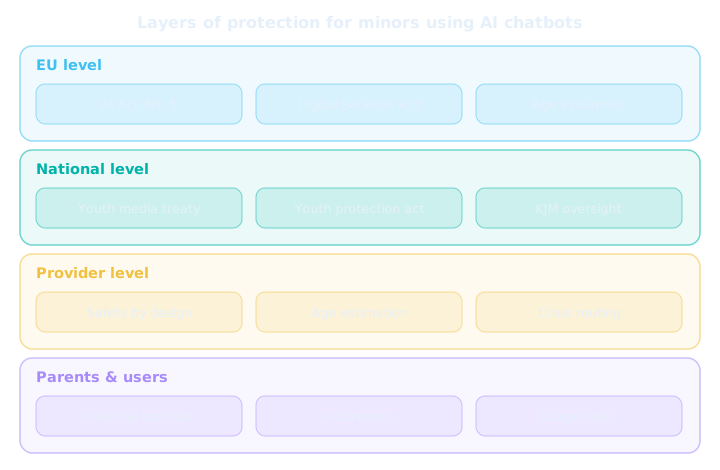
Article 5 of the EU AI Act has prohibited manipulative techniques and the exploitation of age-related vulnerabilities since 2 February 2025. The Digital Services Act requires platforms to protect minors, and in July 2025 the European Commission presented a privacy-preserving age verification app using a zero-knowledge process, with integration into the EU wallet planned for 2026. In Germany, the Commission for the Protection of Minors in the Media has been enforcing recognised age verification since 1 December 2025 and calls for AI systems to be written explicitly into the youth media protection treaty.
Breaches of the Article 5 prohibitions can be fined up to 35 million euros or 7 percent of global annual turnover. For European providers, youth protection is therefore not a voluntary seal of approval but a legal duty with a serious sanction. For how AI security and data protection interlock in a European context, innobu goes deeper in its piece on AI security and data protection.
Challenges and risks
Protection is not a pure win, every measure has side effects. Age verification sits in the tension between youth protection and data protection, and voluntary commitments are often not enough.
The real corporate risk: Running a chatbot without youth protection risks lawsuits, fines and reputational damage, even if minors are not the target group. As soon as children can in fact reach a service, the duties apply. Whoever does not assess the risk still carries it.
What companies should do now
Any company running AI applications that could reach minors should not treat youth protection as optional. The legal and reputational risks rise faster than many roadmaps. Four steps help you stay prepared.

-
Build in safety by design
Run a risk assessment for minors before a chatbot goes live, not after. Define which topics the bot avoids with teenagers and how it responds to crises.
-
Age estimation and age-appropriate modes
Evaluate age estimation methods and offer an age-appropriate mode. When in doubt, the stricter option should be the default rather than relying on self-declaration.
-
Build crisis routing
Define clear escalation on signs of self-harm, with referral to support services and a tested, documented response. Test these paths regularly.
-
Track the legal framework
Watch the EU AI Act, the DSA and national youth protection law on short review cycles and name owners. That way you spot new duties before they turn into a complaint or a lawsuit.
Youth protection for AI chatbots is no longer a niche topic for lawyers in 2026, it is part of any serious product development. Building in safety by design, checking age, and escalating crises in a structured way cuts your risk substantially without slowing AI adoption.
Further reading
Frequently asked questions
On 1 June 2026 Florida became the first US state to sue OpenAI and CEO Sam Altman personally. Attorney General James Uthmeier alleges the company marketed ChatGPT despite known risks to minors, without effective age verification and parental controls. The legal basis is Florida's prohibition on unfair and defective trade practices, and the damages sought could reach into the billions.
According to Common Sense Media (July 2025), 72 percent of US teens have used AI companions at least once and 52 percent are regular users. About a third prefer talking to AI over people for serious or personal conversations. A December 2025 study found that nearly a third of US teens interact with AI chatbots daily.
Article 5 of the EU AI Act has prohibited manipulative techniques and the exploitation of age-related vulnerabilities since 2 February 2025. AI systems that deliberately target children or distort their behaviour are banned. Breaches of the Article 5 prohibitions can be fined up to 35 million euros or 7 percent of global annual turnover.
The Commission for the Protection of Minors in the Media (KJM) has been enforcing recognised age verification systems since 1 December 2025 and calls for AI systems to be written explicitly into the youth media protection treaty and for an independent AI youth protection officer. Generative chatbots that target children or use profiles are treated as high risk.
Four steps are actionable immediately: first, build in safety by design and run a risk assessment for minors before rollout; second, evaluate age estimation and age-appropriate modes, defaulting to the stricter option when in doubt; third, set up crisis routing with clear escalation on signs of self-harm; fourth, track the EU AI Act, the DSA and national youth protection law on short review cycles and assign clear ownership.
Let's collaborate
One contact, a team behind it
Thirty minutes on what you're working on, whether grid, metering, market processes, IT architecture or AI. Afterwards you'll know how we'd approach it and who would sit at the table.
Energy and measurement technology since 2010 · innobu GmbH since 2014 · Based in Schleswig-Holstein, Germany
Whoever pitches also delivers: whoever leads the first call stays your contact right through to the steering committee, with established partners in the project. Direct: info@innobu.com