
The AI Value Gap 2025: 88 Percent Use AI, Only 6 Percent Profit From It
This article works through eight threads: what the McKinsey numbers really say, why the usual diagnosis is mostly wrong, why architecture rather than technology is the real lever, why a named accountable person is needed, why a clear default beats training, how the German and European picture looks, which risks the thesis itself carries and what companies should do now.
McKinsey's State of AI 2025 survey (November 2025, around 1,993 respondents across roughly 105 countries) shows a gap between usage and value: 88 percent of organizations use AI regularly in at least one function, up from 78 percent the year before, but only about 39 percent report any enterprise-level EBIT impact, most of them under 5 percent. Only about 6 percent are AI high performers with more than 5 percent of EBIT attributable to AI. The remaining roughly 94 percent therefore do not have a model problem, they have a value problem. The usual diagnosis, that what is missing is a better model, more training or the right use case, does not hold, because high performers and laggards use the same models. According to McKinsey (March 2025), fundamentally redesigning workflows has the strongest link to EBIT, yet only 21 percent of adopters had fundamentally redesigned any workflow, and CEO oversight of AI governance correlates most strongly with EBIT impact at larger companies. That leads to the architecture thesis: who decides what, with which rules, measured against what. Three levers stand out, a clear default in the workflow, a mandate rather than sheer training volume, and a named, multi-year AI architecture owner. IBM (May 2026) reports that 76 percent of companies have a Chief AI Officer, up from 26 percent a year earlier, but stresses that the mandate matters, not the title. An MIT NANDA study (August 2025) classifies around 95 percent of generative-AI pilots as showing no measurable P&L return and cites an organizational learning gap as the main reason. The numbers have limits: McKinsey measures EBIT through self-reporting, and forced defaults can backfire. For companies that means: name an owner with a mandate, set decision rights, rules and metrics tied to EBIT, rebuild a full workflow and measure value, not licences.
The number most people misread
88 percent of organizations use AI regularly in at least one function, but only about 6 percent draw a meaningful, scaled EBIT impact from it. That is the core finding of McKinsey's State of AI 2025 survey. Anyone who already has AI in the building and still sees nothing in the result is not the exception but the norm. The gap between usage and impact is the real story behind the adoption records.
The numbers reward a closer look. Usage rose from 78 to 88 percent in a single year, almost across the board. Yet only about 39 percent of respondents report any enterprise-level EBIT impact at all, and most of them put it below 5 percent of the result. As AI high performers, with more than 5 percent of EBIT attributable to AI and a reported significant benefit, only about 6 percent qualify, exactly 5.5 percent of the roughly 1,993 respondents across about 105 countries. The survey was fielded in June and July 2025.
From that follows the uncomfortable reading. The remaining roughly 94 percent do not have a model problem, they have a value problem. The AI is there, it is used, and still the impact on the result fails to appear. The same pattern shows up elsewhere: that a high share of initiatives never reaches production is something innobu has already described in its analysis of the AI agents rebuild era . The value gap is not a single finding but a recurring one.
Why the diagnosis is mostly wrong
Three explanations dominate the discussion, and all three miss the point. In most conversations about stalled AI value, one of these three answers comes up. The McKinsey data, however, support none of them, because the difference between the 6 percent and the rest does not lie in the technology. Anyone who gets the diagnosis wrong keeps investing in the wrong thing.
The first answer is: we need the better model. But high performers and laggards draw on the same market of models, often the same providers. The difference lies in the organization, not in model quality. The second answer is: we need more training. Training without authority, however, produces trained people without a mandate, and the usage rate stays low. The third answer is: we need the right use case. Yet scattered individual cases do not add up to EBIT as long as no one owns decision rights and measurement.
How heavily the gap weighs is shown by a widely cited study from the MIT NANDA programme in August 2025. It classifies around 95 percent of the generative-AI pilots it examined as showing no measurable return. As the main reason the authors name not weak models but an organizational learning gap: the tools do not adapt to the workflows, and the organization does not learn to use them well. These findings line up with the older AI productivity paradox , which already showed how AI investment evaporates without organizational change.
The real lever: architecture, not technology
The biggest measurable EBIT lever is the redesign of workflows, not the choice of model. In its March 2025 survey, McKinsey tested around 25 organizational attributes, and the fundamental redesign of workflows had the strongest link to the result. The counter-figure is striking: only 21 percent of adopters had fundamentally redesigned any workflow at that point. The most effective lever was also the one pulled least often.
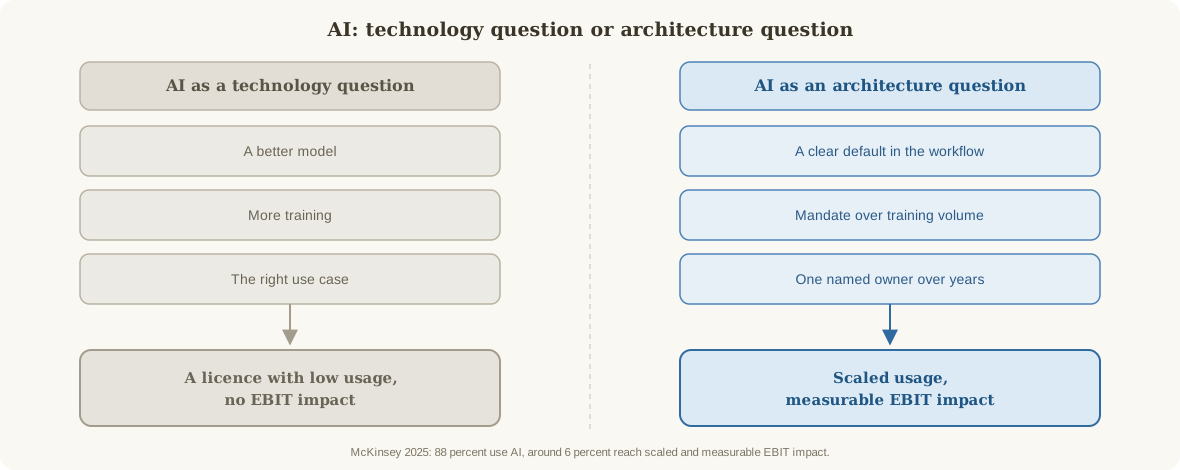
Architecture here does not mean IT architecture but the organizational order. It comes down to three sober questions: who decides what, with which rules, measured against what. An AI architecture question settles decision rights, binding guardrails and metrics tied to EBIT rather than to the number of tools rolled out. As long as AI is treated as a pure technology question, it stays a licence with low usage. Once it is treated as an architecture question, it starts to move the result.
The profile of the high performers confirms the pattern. They are about three times as likely to have fundamentally redesigned workflows and about three times as likely to show strong leadership engagement. More than a third of them put over 20 percent of their digital budget into AI, so they invest substantially about five times as often. The dividing line therefore does not run between good and bad models but between organizations that rebuild their workflows and decision paths and those that simply layer a new tool over old processes.
Accountability with a name: the AI architecture owner
Without a named accountable person, AI stays a licence with low usage. Decision rights, rules and measurement need an owner who holds them together and enforces them across functional boundaries. Practice is moving in that direction, but the title alone achieves nothing.

The numbers show the movement. According to IBM's CEO study from May 2026, 76 percent of companies now have a Chief AI Officer, up from only 26 percent a year earlier. That is a self-report by the boards and should be read with care, but the direction is clear. IBM itself spells out the decisive caveat: what matters is not the title but the mandate, meaning decision authority, clear priorities and guardrails. A Chief AI Officer without authority is just another sign on a door.
That named accountability works is also visible in the public sector. The US administration mandated a Chief AI Officer in every agency as early as 2024, with clear duties and governance bodies, through a memo of the Office of Management and Budget. Alongside the mandate, the time horizon matters. The redesign of workflows and the EBIT impact that follows take years, not quarters. Anyone who fills the role anew every year prevents real accountability. This multi-year point is an argument from the matter, not a documented metric, but it follows directly from the slow path through which the redesign takes effect.
The default beats the training
Whoever wants usage changes the standard path, not just the knowledge. A clear default makes AI the normal tool in the workflow, rather than an option each person has to choose actively. Training conveys skill, a default changes behaviour. The two work together, but the default is the stronger lever on the usage rate.
There are clear examples in practice. In 2025 Shopify declared AI use non-optional internally and anchored AI competence in performance reviews. Anyone who wanted additional headcount first had to justify why AI could not do the work. The default thereby sat on the side of usage. Such rules move the starting point of every working day, and that is exactly where the usage rate is created.
The default has a limit, though, and it should be taken seriously. Duolingo had likewise declared itself AI-first in 2025 and tied AI usage to performance reviews, but withdrew the forced metric after criticism from staff. The lesson is not to abandon defaults but to embed them sensibly rather than enforce them. A further McKinsey finding from its study on so-called superagency fits here: the bottleneck is leadership, not the workforce, and only 1 percent of companies consider themselves AI-mature. The default is a leadership decision, not a training topic.
German and EU perspective
The European picture mirrors the global pattern, often with a wider gap between usage and value. Adoption rises, but value attribution lags, and governance maturity lags too. At the same time the EU, with the AI literacy duty of the AI Act, provides a legal anchor that turns the owner and governance question from a nice-to-have into an obligation.
The figures are sobering. According to the Bitkom study report of February 2026, only about half of AI-using firms can attribute a concrete value contribution. A study by Freshworks from May 2026 puts it that German firms lose around 26 percent of their AI budget on average before any value is created, that only 15 percent have integrated AI into core processes and that 36 percent are stuck in pilots. That figure comes from a vendor and should be read accordingly, but it fits the picture. How fast plain usage is rising in Germany at the same time is shown by the ifo analysis of AI adoption : more than half of companies use AI, without value automatically following.
On the rules side, the EU AI Act acts as an anchor. Article 4 has obliged providers and deployers since 2 February 2025 to ensure sufficient AI literacy in the organization. That turns competence, and with it governance, into a legal duty rather than a voluntary exercise, and gives the owner role a formal hook. Anyone who wants to place the further deadlines and obligations can find them in our piece on the high-risk deadlines of the EU AI Act . A GitLab study from October 2025 shows at the same time that German governance maturity trails the investment: only about 48 percent of the companies surveyed had adapted their processes to the legal requirements.
Challenges and risks
The architecture thesis holds up, but it is no cure-all, and the data have limits. Anyone who overstretches it replaces one myth with the next. An honest framing therefore belongs here, otherwise the justified critique of the model focus turns into a new article of faith.
The first limit lies in the numbers themselves. McKinsey measures the EBIT impact through respondents' self-reports, and the reported statistical link explains only about 20 percent of the variance. That is an indication, not a proof. The widely cited MIT figure of 95 percent likewise refers to pilots without a measurable return, not to failed AI in general, and rests on a small, partly qualitative sample. Both findings support the thesis but do not serve as an exact yardstick.
The second limit is execution. Organizational redesign is slow, expensive and politically delicate. Redistributing decision rights creates resistance, and a named owner can become a bottleneck if they lack authority or resources. On top of that comes the danger of overdoing it: forced defaults can backfire, as the Duolingo example shows. Finally, the framing of architecture over model simplifies on purpose. Data quality, security and the choice of model remain relevant boundary conditions, without which even the best architecture does not hold.
What companies should do now
Treat AI as an architecture question and give it a name, a default and a metric. That is the short answer. The following steps turn usage into impact, and they can be started in the next few quarters without waiting for the next model.

Five steps for the next few quarters
-
Name an owner with a mandate
Appoint a named person accountable for the AI architecture, give them decision authority, budget and a multi-year horizon. The mandate matters more than the title, and continuity matters more than an annual change.
-
Set decision rights, rules and metrics
Clarify concretely who may decide what, with which guardrails for data protection, security and quality, and measured against which figure. Tie the measurement to EBIT, not to the number of licences.
-
Rebuild one workflow end to end
Rebuild a full process rather than scattering many pilots, and set AI as the default there. In the McKinsey data, workflow redesign has the strongest link to the result.
-
Measure value, not licences
Track the actual usage rate in the workflow and the contribution to the result. Switch the metric from the number of tools bought to the real value that usage creates.
-
Bring governance and law together
Connect the owner role with the AI literacy duty of the EU AI Act, so that governance, compliance and value creation pull in the same direction instead of blocking each other.
Further reading
Frequently asked questions
McKinsey's State of AI 2025 survey (November 2025, around 1,993 respondents across roughly 105 countries) shows a large gap between usage and value. 88 percent of organizations use AI regularly in at least one function, up from 78 percent the year before. Yet only about 39 percent report any enterprise-level EBIT impact, and most of them put it below 5 percent. Only about 6 percent qualify as AI high performers with more than 5 percent of EBIT attributable to AI. Near-universal usage meets barely measurable contribution to the bottom line.
Because high performers and laggards use the same models. The difference is organizational. According to McKinsey (March 2025), fundamentally redesigning workflows has the strongest link to EBIT, yet only 21 percent of adopters had fundamentally redesigned any workflow. An MIT NANDA study (August 2025) classifies around 95 percent of generative-AI pilots as showing no measurable P&L return and cites an organizational learning gap, not model quality, as the main reason. A better model, more training or the next use case do not fix that.
Architecture here does not mean IT architecture but the organizational order: who decides what, with which rules and measured against what. An AI architecture question settles decision rights, binding guardrails, a clear default in the workflow and metrics tied to EBIT. McKinsey high performers are about three times as likely to have fundamentally redesigned workflows and more often show strong leadership engagement. As long as AI is treated as a pure technology question, it stays a licence with low usage.
A named owner for the AI architecture makes sense, but the title alone achieves little. According to IBM (May 2026), 76 percent of companies now have a Chief AI Officer, up from 26 percent a year earlier. IBM stresses, however, that what matters is not the title but the mandate, meaning decision authority, clear priorities and guardrails. A multi-year horizon matters too, because workflow redesign and EBIT impact take time. Rotating the role every year prevents real accountability.
Value, not licences. Instead of counting tools bought or people trained, what counts is the actual usage rate in the workflow and the contribution to the result. The sensible move is to rebuild at least one workflow end to end, set AI as the default there and track the effect on EBIT, rather than counting scattered pilots. McKinsey links the largest EBIT impact to fundamental workflow redesign and to CEO oversight of AI governance. The EBIT figures are self-reported, however, and should be read with care.