
Agentic Commerce 2026: When AI Agents Shop for You
Within a few months, Google, OpenAI, Mastercard and Visa have published open protocols for purchase and payment by agents. On 10 June 2026, Shopware from Schoeppingen followed with an agent-native commerce platform. For you as a decision-maker this means the interface between company and customer is shifting.
Agentic commerce describes AI agents that research, compare and buy on a person's behalf. In 2026 the foundation is taking shape from three open standards: the Model Context Protocol for access to shop functions, OpenAI's Agentic Commerce Protocol for discovery and purchase, and Google's Agent Payments Protocol for signed payment approvals, which moved to the FIDO Alliance in May 2026. eMarketer puts US revenue via AI platforms in 2026 at over 20 billion US dollars, rising to 144 billion by 2029, and McKinsey forecasts a global volume of 3 to 5 trillion by 2030. With Shopware from Schoeppingen, which presented an agent-native commerce platform on 10 June 2026, the trend has reached European retail. The biggest hurdle remains trust: only 14 percent of consumers trust an AI to place an order on its own, and 78 percent of financial institutions expect more fraud from AI agents. For companies this means clean, machine-readable product data first, then controlled pilots with limits and a human in the loop.
What agentic commerce is and why now
Agentic commerce is the step where an AI agent does not just prepare a purchase but completes it. Instead of visiting a website, a person states a goal, the agent finds offers, compares prices and triggers the payment, often across several merchants. The push in 2026 comes from three directions at once: larger language models, open protocols for purchase and payment, and commerce platforms that open their functions to agents.
The difference from the classic online shop is fundamental. Until now the website was the place of decision, designed for the human eye. In the agentic web what counts is whether a model can cleanly classify a brand and its products. How web traffic shifts as a result is covered in innobu's piece on the agentic web and the change in web traffic.
The protocol layer: ACP, AP2 and MCP
Three open standards form the foundation, and they solve different problems. The Model Context Protocol makes shop functions readable for agents, the Agentic Commerce Protocol governs product discovery and purchase, and the Agent Payments Protocol secures the payment. Anyone who wants to take part has to understand which layer is responsible for what.
The Model Context Protocol connects AI applications with shop functions and data. It is the interface through which an agent can reach a system's inventory, prices and actions at all.
The Agentic Commerce Protocol from OpenAI and Stripe governs product discovery and purchase. It launched in 2025 with Instant Checkout in ChatGPT and today mainly serves discovery and the handoff to merchants.
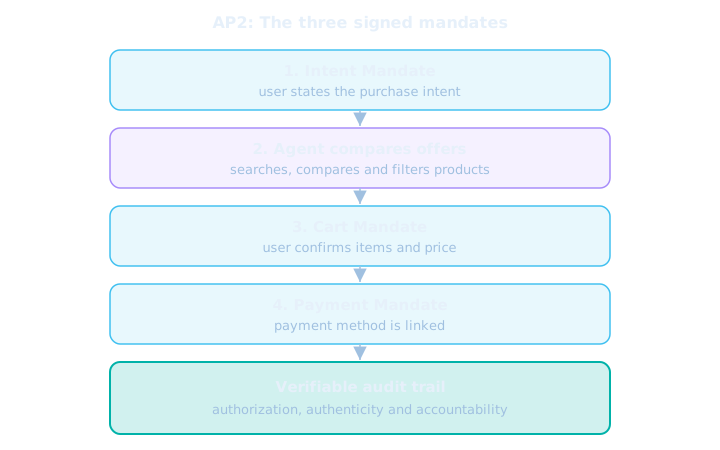
Google's Agent Payments Protocol secures the payment through three signed mandates. It was presented with more than 60 partners and moved to the FIDO Alliance in May 2026.
AP2 shows most clearly how trust is created technically. It breaks every purchase into three cryptographically signed mandates that act as verifiable proof. This produces a traceable audit trail that answers three questions: did the user give the order, does the agent reflect the true intent, and who is accountable if something goes wrong.
Why open standards matter: Mastercard and Visa lead a dedicated payments working group within the FIDO Alliance, and Visa TAP and Mastercard Agent Pay are the network-specific implementations. Choosing an open standard avoids dependence on a single vendor. The flip side: several competing protocols can lead to a standards war.
Shopware Nexus: the German move
Shopware from Schoeppingen presented an agent-native commerce platform at its Community Day on 10 June 2026, showing that the trend has reached European retail. The platform uses the Model Context Protocol so AI applications can address all shop functions, and it stresses control by the merchant.

Shopware Nexus
A data layer that consolidates information from ERP, CRM and PIM and replaces fragmented middleware. It is the basis for agents to receive reliable data.
Shopware Copilot
An agentic assistant with role-based permissions, approval steps and a human in the loop for critical decisions, run on European servers.
Shopware Payments
A payment solution built on PayPal's infrastructure, starting in Germany and Austria. Experience Studio rounds it out, generating shop front ends from prompts.
The emphasis on control is notable. The Copilot acts only within fixed limits, and critical steps require approval. That fits the worry of many merchants about losing the customer relationship to an agent. How companies adopt agents without depending on a single vendor is covered in the piece on AI agent platforms and vendor lock-in.
Figures and market forecasts
The forecasts vary widely because each firm defines agentic commerce differently, yet the direction is clear. Even the cautious estimates see a double-digit share of online retail by 2030. Decision-makers should know the range rather than rely on a single number.
| Source | Forecast | Horizon |
|---|---|---|
| eMarketer | over 20bn US dollars US revenue, 144bn by 2029 | 2026 to 2029 |
| McKinsey | 3 to 5 trillion US dollars global volume | by 2030 |
| Bain | 300 to 500bn US dollars in the US, 15 to 25% of e-commerce | by 2030 |
| Gartner | 20% of digital commerce transactions via AI platforms | by 2030 |
The short-term figures show that the shift is already underway. They are the basis for any investment decision this year.
A Walmart case study shows both sides of the coin. ChatGPT brought roughly twice as many new customers as classic search, yet checkout inside the chat converted at about three times lower rates than a handoff to the retailer's own site. Reach and conversion are two different things. innobu has set out a detailed market analysis in the piece on autonomous AI purchasing agents.
The European perspective
For European companies, agentic commerce combines a market opportunity with a dense rulebook. Payment approvals by agents touch the payment services directive PSD2 and the upcoming PSD3, data processing falls under the GDPR, and from August 2026 further obligations of the EU AI Act apply. Anyone selling in Europe needs protocols that map these requirements.

Technically there is a good fit. Signed mandates and verifiable credentials resemble concepts Europe already pursues, such as strong customer authentication and the EU Digital Identity Wallet under eIDAS 2.0. A payment the user has demonstrably approved is easier to reconcile with European rules.
The German industry association Bitkom reports that 61 percent of retailers see a competitive edge in AI, and in April 2026 it published a white paper on AI trends in e-commerce. At the same time many companies find data protection a burden. Brand control thus becomes a strategic question, because in the agentic web it is not the keyword that decides but how a model knows and recommends a brand. How the EU AI Act and its deadlines interact is covered in the piece on the EU AI Act high-risk deadlines.
Challenges and risks
Agentic commerce is no sure thing, and the honest voices often come from the providers themselves. In early 2026 OpenAI pulled back direct checkout in ChatGPT and moved it into merchant apps, because real-time inventory, tax calculation and product variants are hard to control in practice. That shows how much work lies between a demo and daily operations.
Reach through an agent is not the same as a sale. Far fewer users bought inside the chat than after the handoff to the retailer's own site.
Paraphrased lesson from the Walmart case study, 2026Beware two false conclusions: Waiting until a single standard wins means losing visibility with the agents that already bring customers today. Letting agents buy unsupervised risks fraud, wrong purchases and liability questions. Neither extreme is a strategy; what is needed is a controlled middle path.
What companies should do now
The first step is not buying an agent platform but clean, machine-readable product data. Companies that maintain structured data, clear prices and availability today will be found by agents and shown correctly. Pilots with clear limits follow, not full automation. Four steps help you be prepared.
-
Put product data in order
Structured data, clear prices and stock figures are the basis for an agent to consider an offer at all. Without clean data, a brand stays invisible to agents.
-
Evaluate the protocols
Check which standards such as ACP, AP2 and MCP fit your own sales channels. Favour open standards and European operating models to avoid dependencies.
-
Keep control
Build in approval steps, limits and a human in the loop for critical transactions instead of letting agents buy unsupervised. That keeps the risk manageable.
-
Start small and measurable
Begin with a clearly defined range or channel and measure reach and conversion separately. That proves the value before investing more broadly.
In 2026 agentic commerce is no longer a future topic but a question of preparation. Companies that put product data in order, choose the right protocols and keep control can use the new reach without risking the customer relationship or security. How European companies set up their AI strategy between boom and gap is explored in the piece on the Mittelstand between AI boom and strategy gap.
Further reading
Frequently asked questions
Agentic commerce describes AI agents that research, compare and buy products on a person's behalf, often across several merchants. Instead of clicking through a shop, the person states a goal, and the agent finds offers, compares prices and triggers the payment. This is made possible by open standards for product discovery, purchase and payment.
Three open standards form the foundation. The Model Context Protocol makes shop functions readable for agents. OpenAI's Agentic Commerce Protocol, built with Stripe, governs product discovery and purchase. Google's Agent Payments Protocol secures the payment through three signed mandates and moved to the FIDO Alliance in May 2026, where Mastercard and Visa lead a payments working group.
Shopware, based in Schoeppingen, Germany, presented an agent-native commerce platform on 10 June 2026. It includes Shopware Nexus as a data layer over ERP, CRM and PIM, Shopware Copilot as an agentic assistant with role-based permissions and a human in the loop, Shopware Payments built on PayPal's infrastructure, and Experience Studio. The platform uses the Model Context Protocol and runs the Copilot on European servers.
Estimates vary because each firm defines the term differently. eMarketer puts US revenue via AI platforms at over 20 billion US dollars in 2026 and around 144 billion by 2029. McKinsey forecasts a global volume of 3 to 5 trillion by 2030, Bain projects 300 to 500 billion in the US alone, or 15 to 25 percent of e-commerce. Gartner expects around 20 percent of digital commerce transactions to run through AI platforms by 2030.
The first step is not buying an agent platform but clean, machine-readable product data with clear prices and availability so agents consider an offer at all. After that come evaluating the right protocols and European operating models, plus pilots with limits, approvals and a human in the loop for critical transactions instead of unsupervised full automation.
Let's collaborate
One contact, a team behind it
Thirty minutes on what you're working on, whether grid, metering, market processes, IT architecture or AI. Afterwards you'll know how we'd approach it and who would sit at the table.
Energy and measurement technology since 2010 · innobu GmbH since 2014 · Based in Schleswig-Holstein, Germany
Whoever pitches also delivers: whoever leads the first call stays your contact right through to the steering committee, with established partners in the project. Direct: info@innobu.com