
Claude Fable 5: Anthropic's Most Powerful Model Above Opus 4.8
Anthropic released Claude Fable 5 on 9 June 2026, a new tier above Opus 4.8. The model is built for long, complex and asynchronous work, the kind of task that would otherwise take a person hours, days or weeks. For you as a decision-maker, what matters most is what the model can really do, what changes in the API, and at what point the higher price over Opus 4.8 is justified.
Claude Fable 5 is Anthropic's top model above Opus 4.8, generally available since 9 June 2026, with 1 million tokens of context, up to 128,000 tokens of output, and an official price of $10 per 1 million input tokens and $50 per 1 million output tokens, about double Opus 4.8. Fable 5 and Mythos 5 are the same model: Fable 5 is the public version with safety classifiers that fall back to Opus 4.8 for cybersecurity, biology/chemistry and distillation, while Mythos 5 is the unrestricted version reserved for the Project Glasswing program. By vendor and partner reports, Fable 5 reaches 80.3 percent on SWE-Bench Pro against 69.2 percent (Opus 4.8) and 58.6 percent (GPT-5.5), with an independently measured Intelligence Index of 65 but a high time-to-first-token of about 95 seconds. One new breaking change: an explicit thinking of type disabled returns a 400 error on Fable 5, so you omit the parameter instead. For companies, Fable 5 pays off on genuinely hard, long tasks, while Opus 4.8 remains the pragmatic default for latency- and cost-sensitive cases.
What Claude Fable 5 is and why it matters
Claude Fable 5 is Anthropic's new top model above Opus 4.8 and has been generally available since 9 June 2026. Anthropic positions it as a new tier above Opus and a clear step forward in reasoning, built for long, complex and asynchronous work. For you, that means it is not a faster chat model but a tool for tasks a person would otherwise work on for hours, days or weeks.
The framing is also a business question. Anthropic now carries a high market valuation, as the article on Anthropic's $900 billion valuation and enterprise strategy shows. Fable 5 is the technical flagship of that strategy.
Fable 5 and Mythos 5: one model, two wrappers
Fable 5 and Mythos 5 are the same base model; the only difference is the safety wrapper. Fable 5 is the public version, secured for general use with classifier-based safeguards. Mythos 5 is the unrestricted version, which is not generally available but open only to the Project Glasswing program and select biology researchers.
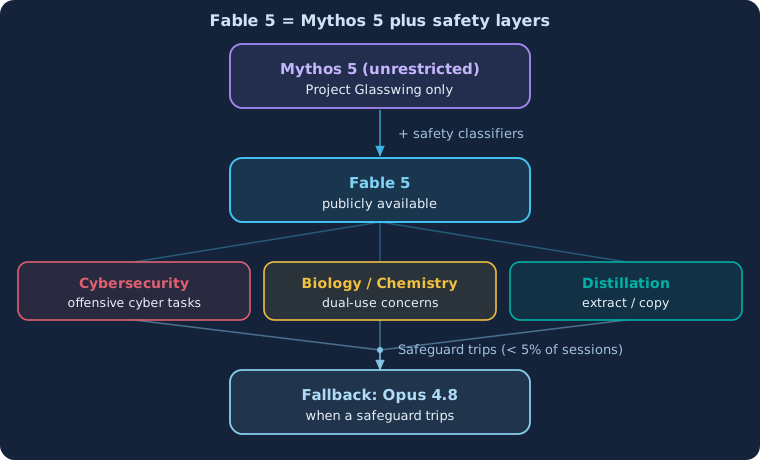
The decisive mechanism is the fallback: when a request trips a safeguard, Fable 5 does not answer with full Mythos-class capability but falls back to Opus 4.8. Anthropic lists three classifier-gated domains.
Cybersecurity
Blocks offensive cyber tasks and attempts to exploit vulnerabilities.
Biology / Chemistry
Falls back to Opus 4.8 for most requests due to dual-use concerns.
Distillation
Prevents attempts to extract or copy the model's capabilities.
The safeguard triggers on average in under 5 percent of sessions. External red-teaming across more than 1,000 hours found no universal jailbreak. Mythos-class models carry a 30-day data retention that is not used for training. How Anthropic handled an earlier unrestricted model is covered in the article on Claude Mythos and the cybersecurity debate.
Benchmarks and capabilities
By vendor and partner reports, Fable 5 leads on nearly every published test. The most relevant number for engineering teams is SWE-Bench Pro, a test of real software tasks: here Fable 5 sits well ahead of Opus 4.8 and GPT-5.5 at 80.3 percent. Treat the numbers with care, they are vendor- and partner-reported and so far only partially reproduced independently.
Source: Anthropic and partners, SWE-Bench Pro (June 2026). Vendor/partner-reported.
Beyond SWE-Bench Pro, Anthropic cites further top results. The table below summarises the reported figures.
| Benchmark / task | Fable 5 result | Context |
|---|---|---|
| SWE-Bench Pro | 80.3% | vs 69.2% Opus 4.8, 58.6% GPT-5.5 |
| Hex analytics | over 90% | first model above this mark |
| Cognition FrontierCode | leading | top at medium effort |
| Hebbia Finance | top performer | senior-level reasoning on documents and tables |
| Intelligence Index | 65 | independent (Artificial Analysis), number 1 in class |
The capability is most visible in partner reports on long, autonomous runs.

Read the numbers with care: SWE-Bench Pro, Hex, FrontierCode and Hebbia are vendor- or partner-reported, and independent reproduction is so far limited. The independent Intelligence Index confirms the leading position but also shows the profile of a reasoning-heavy model: high quality, but noticeable latency. Plan pilot measurements with your own tasks instead of relying on the marketing figures alone.
API and developer details: what changes
Fable 5 shares the request surface of Opus 4.7 and 4.8 with one new breaking change. If you already run on Opus 4.8, you mostly swap the model ID, but you need to watch the changed behaviour for disabled thinking. The table below summarises the key parameters.
| Parameter / feature | Behaviour on Fable 5 |
|---|---|
| Thinking |
adaptive only (thinking: {type: "adaptive"}
); Claude decides its own depth
|
| thinking disabled | new: returns 400; to run without thinking, omit the parameter |
| budget_tokens | removed, returns 400 |
| temperature, top_p, top_k | removed, return 400; steer via prompting |
| Prefills | removed; use structured outputs or a system prompt instead |
| Effort | GA, values low to max, default high, xhigh for coding and agentic work |
| Prompt caching | cacheable from 2,048 tokens, lower than the 4,096 on Opus 4.8 |
Effort is worth re-tuning. The effort parameter affects Fable 5 far more strongly than older models. For long, agentic tasks, Anthropic recommends high or xhigh and advises giving the full task specification up front. Task Budgets (beta) help too: the model sees a running token countdown and self-moderates, unlike the hard max_tokens ceiling it is unaware of.
A practical aside: the 128,000-token maximum output requires streaming, otherwise SDK timeouts occur. And JSON escaping in tool calls can differ, so always parse it with a real JSON parser rather than string-matching. How token-based billing affects coding tools is covered in the article on the pricing shift in AI coding tools.
Pricing and availability
Fable 5 is the most expensive model in the Claude family and costs about double Opus 4.8. The official list price is $10 per 1 million input tokens and $50 per 1 million output tokens. The chart shows the price gap across the four current Claude tiers.
Source: Anthropic API pricing (June 2026).
| Model | Input $/1M | Output $/1M | Context | Max output |
|---|---|---|---|---|
| Claude Fable 5 | 10.00 | 50.00 | 1M | 128K |
| Claude Opus 4.8 | 5.00 | 25.00 | 1M | 128K |
| Claude Sonnet 4.6 | 3.00 | 15.00 | 1M | 64K |
| Claude Haiku 4.5 | 1.00 | 5.00 | 200K | 64K |
The model is available through several channels, with a time-limited free window for subscription plans.
Generally available
$10/$50 per 1 million tokens, full API surface including the server-side tools.
Available
Bare model ID on the Claude platform with full parity; on Bedrock without the server-side Anthropic tools.
Generally available
Enabled for Copilot on 9 June 2026.
Free window for subscription plans
Pro, Max, Team and Enterprise free at first, then dependent on capacity via credits.
When to use Fable 5 vs Opus 4.8
Reach for Fable 5 when the task is genuinely hard and long-horizon and both cost and latency are justified by the outcome. Stay on Opus 4.8 or below when latency or price matter. Anthropic's own guidance is to use the simplest tier that meets the need.

The clean answer is rarely a single model but routing: send simple requests to Sonnet or Haiku, medium ones to Opus 4.8, and only the genuinely hard ones to Fable 5. That way you pay the top price only where it buys a better result.
Migration from Opus 4.8 to Fable 5
Moving from Opus 4.8 to Fable 5 is essentially a model-ID swap plus two checks. Everything that already returns a 400 error on 4.8 continues to return 400 on Fable 5, so nothing changes there if you have already migrated to 4.8.
-
Swap the model ID
Change
model="claude-opus-4-8"tomodel="claude-fable-5". There is no date-suffix variant, the ID is simply claude-fable-5. -
Remove disabled thinking
If your code sends
thinking: {type: "disabled"}, remove the parameter. On Fable 5 it returns 400. To run without thinking, omit the parameter entirely. -
Re-tune effort and plan the budget
Re-tune effort, give the full task specification up front, and budget for the higher token price and latency. For long runs, high or xhigh plus a Task Budget is sensible.
More on running long, autonomous loops in practice is in the article on Claude Code routines and cloud automation.
European perspective
For European companies, three points stand out: data retention, cost control, and the framing under the EU AI Act. The Mythos class, to which Fable 5 belongs, carries a 30-day retention that, per Anthropic, is not used for training. Check that against your own GDPR requirements and data-processing agreements before production use.
The output price of $50 per 1 million tokens disciplines long agent runs noticeably. Over multi-day autonomous work, output tokens add up quickly, which makes hard budget control via Task Budgets and max_tokens a requirement, not an option.
Then there is the regulatory view. High autonomy and long runs touch transparency and oversight duties: anyone letting a model work independently for days needs traceable logs, clear accountability, and human control at the right points. Governance structures for that are described in the article on AI agent governance in the enterprise.
Challenges and risks
A balanced assessment separates marketing from proven capability. Three points deserve particular attention before Fable 5 moves into production workflows.
The high time-to-first-token of about 95 seconds is not an infrastructure problem but a sign of deep upfront reasoning. Design the user experience around asynchronous flows and streaming, not around chat-level snappiness.
Based on the measurements by Artificial Analysis, 2026Three open points: First, benchmark independence, since the top results are vendor- and partner-reported. Second, latency, which rules out interactive applications. Third, the free window, which is explicitly tied to a capacity expansion, after which sustained availability on Pro and Max depends on credits. On top of that, the safety fallback can quietly lower answers in gated domains to Opus level without you noticing right away.
What companies should do now
Test Fable 5 on a genuinely hard task, measure cost and latency, and keep Opus 4.8 as the default. That way you use the top capability without spoiling your budget and response times.
Pilot deliberately
Pick a hard, long task, set effort and a Task Budget, and measure cost per outcome rather than per request.
Set up model routing
Send simple cases to Sonnet or Haiku, medium ones to Opus 4.8, and only the hard ones to Fable 5.
Settle governance
Define data retention, logging and human control before long autonomous runs go into production.
Fable 5 is Anthropic's most powerful model and a real step above Opus 4.8, but not a default for every request. Companies that use it deliberately for hard, long tasks, measure the cost, and build clean model routing capture the value without losing sight of budget and latency.
Further reading
Frequently asked questions
Claude Fable 5 is Anthropic's top model, generally available since 9 June 2026 and positioned as a new tier above Opus 4.8. It offers a 1 million token context window, up to 128,000 tokens of output, and costs $10 per 1 million input tokens and $50 per 1 million output tokens. It is built for long, complex and asynchronous tasks.
Fable 5 and Mythos 5 are the same base model. Fable 5 is the public version with added safety classifiers, while Mythos 5 is the unrestricted version available only to the Project Glasswing program and select biology researchers. When a safeguard triggers, Fable 5 falls back to Opus 4.8.
Fable 5 officially costs $10 per 1 million input tokens and $50 per 1 million output tokens, about double Opus 4.8 ($5 and $25). Some third-party trackers show a blended input price around $12.50; for budgeting, use the official list price of $10/$50.
The new behaviour is that an explicit thinking of type disabled returns a 400 error on Fable 5, while Opus 4.7 and 4.8 accept it. To run without thinking, omit the parameter entirely. Everything that already returns 400 on 4.8, such as budget_tokens, temperature, top_p, top_k and prefills, continues to return 400 on Fable 5.
Use Fable 5 for genuinely hard, long tasks such as large migrations, multi-day autonomous coding, deep research or vision-heavy reasoning, when cost and latency are justified by the outcome. Stay on Opus 4.8 or below when latency matters, because Fable 5 has a time-to-first-token of about 95 seconds, or when price is decisive.
Fable 5 is available through the Anthropic API, the Claude platform on AWS, Amazon Bedrock and GitHub Copilot. Pro, Max, Team and Enterprise plans had a free access window through 22 June 2026, after which access depends on usage credits subject to capacity. Mythos 5 stays limited to the Project Glasswing program.
Let's collaborate
One contact, a team behind it
Thirty minutes on what you're working on, whether grid, metering, market processes, IT architecture or AI. Afterwards you'll know how we'd approach it and who would sit at the table.
Energy and measurement technology since 2010 · innobu GmbH since 2014 · Based in Schleswig-Holstein, Germany
Whoever pitches also delivers: whoever leads the first call stays your contact right through to the steering committee, with established partners in the project. Direct: info@innobu.com