Black Mirror Was Yesterday: These Technologies Already Exist
Open-source humanoids for $15,000, WiFi tracking through walls for $50, 3D-printed rockets for under $100. What sounds like science fiction is reality in 2026. A stocktake of the technologies that are changing everything right now.
Technologies that were science fiction until recently are now accessible to anyone in 2026. Asimov Inc. has released the complete design of a humanoid robot as open source, Figure AI demonstrates autonomous room cleaning via neural networks, and the open-source project RuView tracks people through walls using WiFi signals. At the same time, autonomous weapons and OSINT tools are being democratised. The same technologies that advance elderly care and research also enable comprehensive surveillance and garage weapons production.
The $15,000 Humanoid You Can Build Yourself
Manual labour jobs are currently considered least affected by AI. But something is happening right now that could upend this assessment in the coming years.
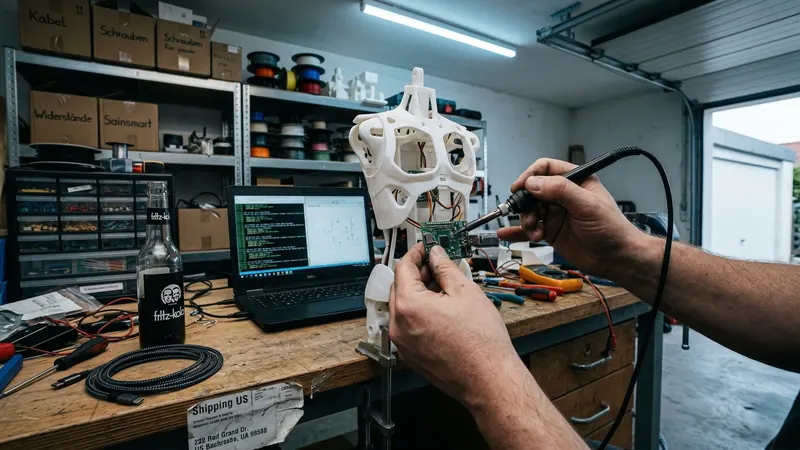
Open source is fundamentally changing robotics: Asimov Inc. has released the complete body design of their humanoid robot as open source. Not just a few CAD files, but the full package to build yourself a 1.2-metre humanoid with over 25 degrees of freedom.
The "Here Be Dragons" DIY kit features modular architecture and 3D-printed structural components. Pre-orders require a $499 deposit, with delivery following in a few months.
Until now, humanoid projects were either academic curiosities or six-figure expenses. Asimov deliberately chose a model that does not require mass production. For the first time, a complete humanoid design is openly available.
Soon you will be able to "programme" your robots in natural language, just like working with ChatGPT or Claude. The community is understandably excited.
Why Robots Are Different From Any Human Worker
Figure AI has released a demo described as "the most impressive robotics demo of 2026". Their Helix 02 autonomously tidies a living room. Not pre-programmed, but through a single neural network that controls the entire body directly from pixels.
Identifying objects, picking them up, sorting, throwing cushions, grabbing remote controls. All coordinated, in real time. Figure AI CEO Brett Adcock calls it "whole body, end-to-end living room cleanup".
What makes it special: The system does not learn through better algorithms, but through more data. New capability? Feed in more training examples, done. Scaling instead of engineering.
This is the decisive difference from human workers. When one robot learns a task, all others can do it immediately too. Not in weeks. Not through training programmes. Immediately. One software update, and a thousand units master the new skill.
They never get tired, need no breaks, and can be mechanically extended at will. Two thumbs on one hand? No problem. Four arms? Why not.
From the Living Room to the Battlefield
If robots can tidy living rooms, what else can they do? Reality already provides the answer.
In February 2026, US company Foundation sent its Phantom MK-1 humanoids as a test to the Ukrainian front. By all available accounts, the first humanoid robots in an actual combat zone. Officially for reconnaissance, but the direction is clear.
Ethical dilemma: Anthropic wants to contractually stipulate that their models are not used for mass surveillance or fully autonomous weapons. But when Anthropic says no, OpenAI and xAI step in to fill the gap.
Palmer Luckey, inventor of Oculus and founder of Anduril, says humanoid soldiers are "probably still a few years" from actual combat deployment. Meanwhile, Anduril is bringing online a weapons factory producing autonomous combat drones, underground weapons systems, and autonomous fighter jets.
Open-source robotics takes off
First complete humanoid designs are released as open source. The maker community begins building their own robots.
Humanoids at the front
Foundation sends Phantom MK-1 humanoids as a test to the Ukrainian front, the first humanoid robots in an actual combat zone.
Autonomous weapons factories
Anduril brings online a factory producing autonomous combat drones and fighter jets. Autonomous weapons can be stored for years and activated on demand, like preserved food. Only lethal.
DIY rockets for under $100
3D-printed rockets can be built at home for under $100. The technology is freely available.
Autonomous weapons can be stored for years and activated on demand, like preserved food. Only lethal. We have even reached the point where 3D-printed rockets can be built at home for under $100.
Surveillance Without Cameras
You do not need to look at billion-dollar defence contractors to understand the magnitude. RuView (formerly WiFi DensePose) went viral on GitHub, gaining nearly 40,000 GitHub stars .
The open-source project uses ordinary WiFi signals and inexpensive chips to track human movements and body poses through walls. No camera needed. Cost: a few euros for the chips. Available and feasible for anyone.
Motion Detection
Detects human movements and body poses through walls without line of sight.
Vital Signs
Captures heart rate and breathing frequency contactlessly, without wearables or cloud connectivity.
Minimal Cost
Total hardware cost under $50. Everything runs locally on the device.
The system detects not only where someone is, but also how they are doing: heart rate, breathing frequency, body posture, falls. All through walls, without cameras, wearables, or cloud.
Because no videos or images are created and everything runs locally on the device, the system can potentially be operated in compliance with HIPAA and GDPR .
Potential for regulation-compliant health monitoringFor elderly care or disaster relief, this is genuinely helpful. But the same technology also makes it possible to track people without their knowledge, invisibly, from the next room, with $50 hardware.
Intelligence Tools for Everyone
At the same time, the world of Open Source Intelligence (OSINT) is being democratised. Tools like Worldmonitor (built by music streaming CEO Elie Habib) and Shadowbroker aggregate data and live feeds from publicly accessible sources in real time.
Many of these OSINT tools now use AI. What was once reserved for intelligence agencies now runs as a Python script on your laptop. The combination of publicly available data and AI analysis makes information accessible that would have been classified just a few years ago.
Our Take: The Dual Nature of Technology
All of this sounds like science fiction. But it is not anymore. Each of these technologies has real positive potential:
Health
WiFi tracking for fall detection in elderly care. Contactless vital sign monitoring without wearables.
Accessibility
Open-source robot hands for affordable prosthetics. Maker rockets for research and education.
Transparency
OSINT for investigative journalism. Drones delivering medication to remote areas.
But the same tools also enable scenarios we previously only knew from Black Mirror: comprehensive surveillance without cameras, autonomous weapons buildable in any garage, and intelligence tools on every kitchen table.
The question is no longer whether these technologies will be used for malicious purposes. Only when. Machines are learning to move in the physical world. Understanding, grasping, walking, flying. One research line behind this is the world model, explained in our piece on JEPA and energy-based models. This is simultaneously the most exciting and most unsettling development in technology right now.
Regulation is lagging behind. The EU AI Act addresses AI risks, but the hardware side, 3D-printed weapons, WiFi tracking kits, open-source robots, largely falls through the regulatory net. The speed at which these technologies are being democratised exceeds the ability of any regulatory body to keep pace.
What remains is individual responsibility. The maker community building Asimov robots must be aware of what they are creating. The developers of WiFi tracking must think beyond the care use case. And we all need to have the discussion about what boundaries we want to draw as a society before technology makes that decision for us.
Further Reading
Frequently Asked Questions
The "Here Be Dragons" DIY kit costs $15,000, close to pure material cost. Pre-orders require a $499 deposit. The robot stands 1.2 metres tall, weighs 35 kg, has over 25 degrees of freedom, and uses modular architecture with 3D-printed structural components.
The open-source project RuView uses ordinary WiFi signals and inexpensive chips (under $50) to detect human movements and body poses through walls. The system can capture heart rate, breathing frequency, body posture, and falls without cameras, wearables, or cloud connectivity. Everything runs locally on the device.
Yes. In February 2026, US company Foundation sent its Phantom MK-1 humanoids as a test to the Ukrainian front. By all available accounts, these were the first humanoid robots in an actual combat zone, officially deployed for reconnaissance. Palmer Luckey, founder of Anduril, estimates humanoid soldiers in actual combat are "still a few years" away.
OSINT stands for Open Source Intelligence, the systematic analysis of publicly available data. Tools like Worldmonitor and Shadowbroker aggregate data and live feeds from public sources in real time, using AI-powered analysis. What was once reserved for intelligence agencies with billion-dollar budgets now runs as a Python script on an ordinary laptop.
WiFi tracking can detect falls contactlessly in elderly care. Open-source robot hands enable affordable prosthetics. Maker rockets serve research and education. OSINT supports investigative journalism and transparency. Drones can deliver medication to remote areas. The dual-use problem requires societal discussion about boundaries.
The EU AI Act addresses AI risks and classifies systems by risk level. However, the hardware side, such as 3D-printed weapons, WiFi tracking kits, and open-source robots, largely falls through the regulatory net. The speed of technology democratisation exceeds the ability of regulatory bodies to keep pace.