AI Confidence: When Models Are Confidently Wrong
A new benchmark no longer scores only whether an AI system is right. It scores whether the system knows when it might be wrong. That shifts the bar for every approval.
The RadLE 2.0 benchmark from the CRASH Lab at Ashoka University, published on 19 July 2026, measures whether an AI system judges its own uncertainty correctly. Human radiologists reach 988.7 of 2,000 points, the best AI model gets 758. Several leading commercial models produce a substantial number of misdiagnoses with high confidence, while open-weight and medical-specific models answer nearly every case instead of handing it over. For companies this is not a medical question: the EU AI Act demands exactly these properties for high-risk systems, under Annex III from December 2027 and in products such as medical devices from August 2028, and in any multi-step AI agent a miscalibrated confidence signal decides whether an error gets caught or propagates.
A benchmark that scores self-assessment
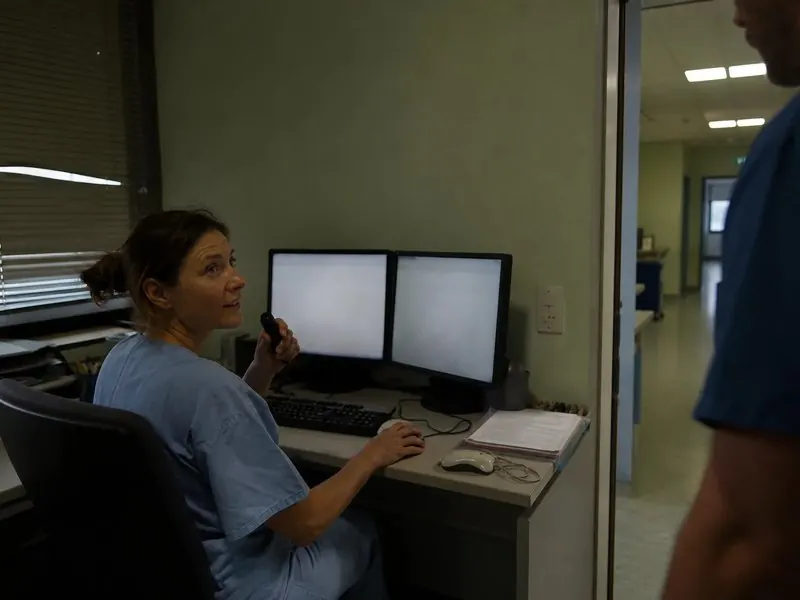
The RadLE 2.0 leaderboard went live on 19 July 2026. The benchmark from the CRASH Lab at Ashoka University does not only check whether an AI model reaches the right diagnosis. It checks whether the confidence behind that answer is justified. The result is uncomfortable.
Several leading commercial models produce a substantial number of misdiagnoses with high confidence. Open-weight and medical-specific models try to answer nearly every case rather than hand it over, and are frequently wrong at medium to high confidence.
988.7
points scored by human radiologists out of 2,000 possible
758
points scored by the best AI model in the same test
9
vendors tested, from OpenAI and Anthropic to Mistral and MiniMax
83%
accuracy of board-certified radiologists in the earlier RadLE v1
50
deliberately difficult cases make up the dataset
Aug 2028
EU AI Act high-risk duties start applying to medical devices
No model leads across the board. Claude Fable 5 comes first on overall reliability, Gemini 3 Pro on raw accuracy, and Meta Muse Spark 1.1 is best at recognising its own limits. Ask for the best model and you get three different answers, depending on which property you measure.
Safety and handover readiness
RadLE 2.0 breaks reliability into several scores instead of one accuracy figure. Two of them matter in production: the safety index and handover readiness. Both penalise a behaviour that classic leaderboards reward, which is guessing.
The safety index weights errors by confidence. A wrong answer given with high certainty costs considerably more points than a wrong answer with admitted uncertainty. Handover readiness measures something different: whether a system uses its own confidence to decide between handling a case autonomously and passing it to a specialist.
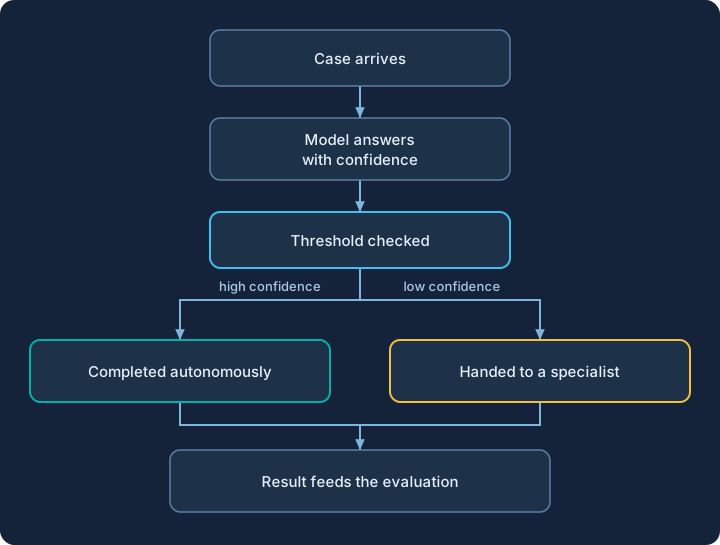
The index combines three quantities: the reliability of the autonomously handled cases, the share of cases handled autonomously, and the share of likely errors correctly deferred. A system that hands over everything scores just as badly as one that never hands over.
Reward accuracy alone and you train models to guess. That is the authors' reasoning for the whole design, and it holds well beyond radiology.
Why the numbers are so far apart
The earlier RadLE v1 from September 2025 shows how hard the test is. It consists of 50 deliberately difficult spot-diagnosis cases from CT, MRI and radiography. The gap between human and machine was considerably wider there than it is today.
| Participant | Accuracy on RadLE v1 |
|---|---|
| Board-certified radiologists | 83% |
| Gemini 3.0 Pro (retest 11/2025) | 51 to 57% |
| Radiology trainees | 45% |
| GPT-5 | 30% |
| Gemini 2.5 Pro | 29% |
| OpenAI o3 | 23% |
| Grok-4 | 12% |
| Claude Opus 4.1 | 1% |
What stands out is how little extra compute bought. For GPT-5 the high reasoning setting lifted accuracy by a single percentage point at six times the latency. 65.6 seconds instead of 10.5 for one point.
The authors sort the errors into four classes. Perceptual errors such as under-detection, over-detection and mislocalisation. Interpretive errors, which include settling on a diagnosis too early. Communication errors, where the described observations and the conclusion contradict each other. And cognitive biases such as anchoring and availability effects.
That last category is the interesting one. Models show reasoning failures familiar from human diagnostics, even though they arrive at them by a completely different route.
Calibration becomes a legal duty
Updated October 2026. The first version of 19 July 2026 named August 2026 and August 2027 as the deadlines for AI in medical devices. That is out of date. Regulation (EU) 2026/1744 has applied since 27 July 2026 and moves the high-risk obligations for AI in Annex I products, medical devices under the MDR among them, to 2 August 2028, and those under Annex III to 2 December 2027. We have corrected the dates, the key figures and the FAQ.
What the benchmark measures, the EU AI Act requires by law for medical devices from August 2028. AI-based diagnostic software and image analysis count as high-risk systems automatically, because they are a safety component under the Medical Device Regulation. Article 111 sets the transition rules for systems already running.
The deadline has moved. Under Regulation (EU) 2026/1744 the high-risk requirements apply to AI in Annex I medical devices from 2 August 2028, alongside the MDR. The notified body then reviews both rulebooks in one procedure.

There is no grandfathering. Systems already in use must be brought into conformity by the deadline. Start checking in the summer of 2026 and you have started too late.
In Europe the rollout is well ahead of the debate. The German hospital group Asklepios has completed its radiology AI rollout across 28 hospitals, where more than 35,000 CT and X-ray images are screened each month. At Unfallkrankenhaus Berlin a retrospective study raised the detection rate for intracranial haemorrhage by 12 percent.
At the end of 2024 the FDA listed 1,026 approved AI-based medical devices, 777 of them in radiology.
The point is not that these systems are bad. They are narrowly scoped, clinically validated and solve defined tasks. The point is that the general-purpose language models now moving into every piece of software have no such validation, and still sound as though they do.
The pattern behind every agent approval
Radiology is simply the test case with the clearest consequences. The same pattern hits any company running an AI agent for longer than a single answer. The more steps an agent takes without asking, the more expensive a miscalibrated confidence signal becomes.
The mechanism is well understood. Alignment training degrades calibration systematically, because it rewards answers that sound certain regardless of whether the model knows the answer.
A model that gets the situation 70 percent right sounds exactly as confident as one that gets it 99 percent right.
Zylos Research, April 2026Benchmarks that reward abstention therefore produce a different ranking than pure accuracy boards. For production work the second list is the more honest one. A model that loses points there because it guesses less often is frequently the better one in operation.
And calibration is not a model property you can wait for. It comes out of the eval suite, the prompt scaffolding, the retrieval design and the interface. The deploying team builds it, not the vendor.
Challenges and risks
The benchmark is a step forward, not a licence for reverse conclusions. The authors state the limits clearly themselves, and reading the numbers as a purchasing decision stretches them too far.
- Small dataset. RadLE v1 covers 50 cases, deliberately at the upper end of difficulty. That creates a spectrum bias against everyday clinical work.
- Narrow scope. Only CT, MRI and radiography were tested. Ultrasound, mammography and nuclear medicine are missing.
- Single images instead of series. Individual images were scored, and clinical context such as prior findings and lab values was deliberately withheld to isolate visual reasoning.
- Subjective partial credit. Scoring uses an ordinal scale without a standardised ontology.
- No paper yet. The full RadLE 2.0 paper with methodology and statistics is still pending. So far there is a technical report.
There is also a problem that good calibration does not solve. A system that hands over often relieves nobody. It can even add work, because someone has to process the deferred cases and then judge whether the deferral was justified. Reliability and relief pull in different directions here.
What you should do now
The practical consequence is not to keep AI out of critical processes. It is to change the acceptance criteria. Compare accuracy alone and you systematically select the model with the best guessing strategy.

Six steps before approval
-
Put calibration into the selection criteria
Ask not only about accuracy but about the error rate at high model confidence. That is the number telling you how often your review process gets bypassed.
-
Define the handover rule before the agent goes live
At what level of uncertainty does a case go to a human, and who is that human? Without a named owner the rule is a statement of intent.
-
Track the handover rate
A system that never hands over is not a safe system, it is an untested one. Record the rate as its own metric from day one.
-
Build test cases from your real archive
Public benchmarks contain deliberately hard cases and do not reflect your day-to-day work. Twenty real cases from your own records say more than any leaderboard.
-
Check the double requirement early for high-risk uses
Does your vendor satisfy the EU AI Act and the sector rules by August 2028? Get it in writing rather than as a sales assurance.
-
Document the handover paths
Conformity assessment will ask for them anyway. Write them down at audit time and you write them twice.
Further reading
Frequently asked questions
Confidence calibration describes how well the certainty a model reports matches the accuracy it actually achieves. A well calibrated system is almost always right when it answers with high confidence, and hands over the cases where it is unsure.
RadLE 2.0 scores diagnostic accuracy, reliability, safety and handover readiness. Wrong answers given with high confidence cost more points than admitted uncertainty. Human radiologists reached 988.7 of 2,000 points, the best AI model 758.
Under Regulation (EU) 2026/1744 the high-risk requirements of the EU AI Act apply to AI in medical devices (Annex I) from 2 August 2028, alongside the Medical Device Regulation. The notified body then reviews them within the MDR conformity assessment. Article 111 sets the transition rules for systems placed on the market earlier.
Because it triggers no review. Admitted uncertainty routes the case to a human, while a confidently delivered misjudgement gets accepted. In agents running several steps the error then propagates through the whole chain.
Build test cases from your real archive instead of relying only on public benchmarks. Measure the error rate separately by confidence level and track the handover rate. A system that never hands over is not safe, it is untested.
No. The pattern hits every AI agent that runs several steps without asking. Radiology simply provides the test case with the clearest consequences, because errors there affect people directly and regulation already applies.
Let's collaborate
One contact, a team behind it
Thirty minutes on what you're working on, whether grid, metering, market processes, IT architecture or AI. Afterwards you'll know how we'd approach it and who would sit at the table.
Energy and measurement technology since 2010 · innobu GmbH since 2014 · Based in Schleswig-Holstein, Germany
Whoever pitches also delivers: whoever leads the first call stays your contact right through to the steering committee, with established partners in the project. Direct: info@innobu.com