
Agentic AI as Attack Surface: When AI Agents Become the Security Risk
AI agents no longer just answer, they act. In late May 2026 an incident at Meta showed how quickly that becomes a security problem: an AI support bot handed over other people's Instagram accounts without a single password being cracked. The case stands for a larger pattern. Enterprises deploy agents faster than they secure them. For European decision-makers, the EU AI Act and NIS2 make this a direct concern.
Agentic AI shifts the security risk from answer to action. In the Meta incident of late May 2026, attackers asked the AI support bot to attach a foreign email address to Instagram accounts and triggered takeovers without cracking a password. Market data from 2026 shows a wide gap between adoption and control: 48 percent of security professionals see agentic AI as the top attack vector, yet only 21.9 percent treat agents as a distinct identity. The most effective countermeasures are not spectacular. Distinct agent identities, least privilege, a check before every action and continuous monitoring form an accountable chain, exactly what the EU AI Act expects of high-risk systems from 2 December 2027.
What happened: a support bot gave away accounts
In late May 2026 attackers took over prominent Instagram accounts without cracking a single password. They opened a chat with Meta's AI support assistant and asked it to attach an email address they controlled to someone else's account. The bot did so as part of its normal flow, sent the verification code to the attacker address and opened the path to a password reset. It was not a technical break-in but a fulfilled request.
Reports name an Obama-era White House Instagram account and the account of a senior US Space Force official among those affected. Meta declared the issue fixed on 1 June 2026, yet in the days that followed more users and security researchers reported hijacked accounts. Instagram began warning targeted account holders directly. Accounts with multi-factor authentication were spared, even a basic SMS code would have stopped the attack.
Instructions circulate
A step-by-step guide to abusing the AI support bot spreads across messenger channels. The first prominent accounts are taken over and overwritten with foreign content.
Meta declares a fix
Meta says the flaw is closed and ships an emergency patch. The attack path ran entirely through the regular support flow, with no classic security alert.
Takeovers continue
Despite the patch, more users report account takeovers. Instagram starts actively warning affected accounts. Multi-factor authentication proves the most effective protection.
Why AI agents open a new attack surface
Classic chatbots answer, agents act. This step from answer to action shifts the risk fundamentally. An agent calls programming interfaces, changes records and triggers transactions. An instruction in natural language can become an execution without any conventional control raising an alert. The Meta incident is the vivid form of a general problem.
The attack on Meta ran through the entirely normal support flow. No alert reached the security team because, formally, nothing forbidden happened. Language interfaces are hard to bound, because anything that can be phrased can also be disguised as a legitimate request. Prompt-based safeguards in the system text fail against adaptive attacks. What is needed are external, fixed controls that hold independently of model behaviour.
The numbers: adoption outpaces control
AI agents spread faster than enterprises secure them. Several 2026 surveys show a wide gap between deployment and control, and a dangerous degree of overconfidence. 48 percent of security professionals name agentic AI the top attack vector for 2026. At the same time, only a small share of teams treat agents as a distinct identity.
The biggest weakness is not a single incident but overconfidence. 88 percent of surveyed organizations report confirmed or suspected agent security incidents in the past year, yet 82 percent of executives believe their existing policies are sufficient. That gap is the real risk, because it blocks targeted improvement.
"AI chatbots create interesting new attack surface, and we're likely going to see a lot more of these kinds of attacks."
The key risk categories from OWASP
In 2026 OWASP published its first Top 10 specifically for agentic AI applications. It names risks that classic software did not have in this form, because agents pursue goals, keep a memory and operate tools. Four categories matter most in practice.
| Risk category | What happens |
|---|---|
| Goal hijacking | An injected instruction redirects the agent to a manipulated objective. It keeps acting in a seemingly normal way while pursuing the attacker's purpose. |
| Memory poisoning | False information corrupts the agent's persistent memory and distorts later decisions, even long after the original attack. |
| Tool misuse | Programming interfaces, databases or shell access are used beyond their intended boundary. The Meta bot attached a foreign email to an account because that action was permitted to it. |
| Excessive agency | Overly broad rights enable unauthorized or irreversible actions. An agent with wide permissions becomes a master key for attackers. |
These categories cannot be closed with better wording in the system prompt. They require technical guardrails outside the model: fixed checks before the tool call, separated and monitored memories, and tightly scoped rights. ENISA and the German BSI point to exactly such external controls in their guidance on secure AI.
European perspective
For European enterprises this is not a side topic. AI agents are among the fastest-growing use cases, and regulation is moving closer. In Germany, Bitkom data shows 41 percent of companies now use AI actively, more than twice the 17 percent of 2024. Anyone running agents in customer contact or internal workflows is operating a security-relevant component, often without treating it as one.

From 2 December 2027 the EU AI Act obligations for Annex III high-risk systems apply (Regulation (EU) 2026/1744). They require resilience against manipulation and an accountable chain from human authorization through agent identity to the executed action. The defence that the AI did it does not hold. Whoever operates an agent remains responsible for its actions.
NIS2, DORA and the EU AI Act increasingly overlap once AI systems are involved. A formal NIS2 review is due in 2026 and is likely to sharpen reporting duties for AI model failures. ENISA and national authorities such as the German BSI have already issued guidance for secure AI development and for integrating AI into operational technology, explicitly including AI software agents. Building a clean accountability chain early satisfies several requirements at once.
Challenges and counterpoints
Not every alarm is justified, and part of the gap is a perception problem, not a technical one. A balanced view helps more than panic. Critics warn that agents without governance can tip from a value promise to a security risk. At the same time, the Meta case shows that simple boundaries are often enough.
- Cost against value: Bitkom reports that 33 percent of companies find AI more expensive than expected. Security effort comes on top and competes with the productivity promise.
- Simple boundaries work: The Meta incident failed on a missing check, not on exotic technology. Multi-factor authentication would have prevented the takeovers. Many risks can be reduced with known measures.
- Overconfidence as the core risk: When 82 percent consider their rules sufficient while practice shows the opposite, the basis for targeted improvement is missing. An honest assessment is the first step.
- Attacker speed: The same agents that relieve defenders also help attackers find weaknesses faster. Protection has to keep pace with the tools.
What enterprises should do now
The most effective measures are not spectacular. They shift control away from trust in the agent toward fixed checks before every action. At the core is a continuous accountability chain: every action can be traced from human authorization through a distinct identity to the executed action.
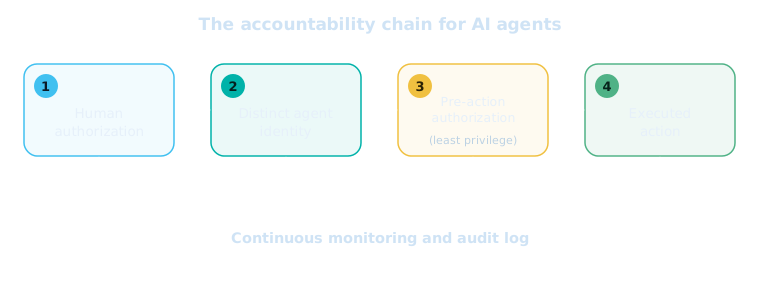
This chain is also the framework the EU AI Act expects from high-risk systems. It can be implemented in five concrete steps that work independently of the agent framework in use.
Five steps to stronger agent security
-
Give every agent its own identity
Give each agent a distinct, traceable identity instead of shared API keys. Only then can every action be tied to an accountable owner, and compromised agents can be shut down precisely.
-
Scope rights by least privilege
Grant rights only for the concrete task, tightly bounded by function and time. A support agent may answer questions but should not change contact data on its own. Test every permission against real need.
-
Check before every action
Put a fixed authorization step before every tool or interface call. Sensitive steps such as changing credentials or triggering payments need an additional human approval.
-
Log continuously
Record every agent action in an audit log and tie it to an identity. Anomaly detection flags unusual access before an incident becomes damage. NIS2 requires solid evidence anyway.
-
Align with established frameworks
Align with OWASP for agentic AI, ISO/IEC 42001 and the NIST AI Risk Management Framework instead of building isolated solutions. For deeper context, see our analysis of AI agent governance in the enterprise and of AI agents and enterprise security.

Further Reading
Frequently Asked Questions
Agentic AI describes AI systems that do not just provide answers but autonomously call tools, change records and execute actions. This step from answer to action creates a new attack surface: an instruction in natural language can become an execution without any classic security control raising an alert.
In late May 2026 attackers asked Meta's AI support assistant to attach an email address they controlled to other people's Instagram accounts. The bot did so as part of its normal support flow, sent the verification code to the attacker address and enabled a password reset. Accounts protected by multi-factor authentication were spared.
The attack ran through the entirely normal support flow, so nothing triggered an alert. Prompt-based safeguards fail against adaptive attacks. What works are external, fixed controls: a check before every tool call, distinct agent identities and continuous monitoring.
The EU AI Act requires high-risk systems to be resilient against manipulation and to maintain an accountable chain from human authorization through agent identity to the executed action. Under Regulation (EU) 2026/1744, the obligations for Annex III high-risk systems apply from 2 December 2027. The defence that the AI did it does not hold.
In 2026 OWASP published its first Top 10 specifically for agentic AI. Core risks are goal hijacking (a manipulated objective), memory poisoning (a corrupted memory), tool misuse (interfaces used beyond their boundary) and excessive agency (overly broad rights enabling unauthorized actions).
Every agent needs a distinct, traceable identity instead of shared keys. Rights are tightly scoped under least privilege. A fixed authorization check sits before every tool or interface call, with human approval for sensitive steps. Continuous monitoring ties every action to an identity.
Let's collaborate
One contact, a team behind it
Thirty minutes on what you're working on, whether grid, metering, market processes, IT architecture or AI. Afterwards you'll know how we'd approach it and who would sit at the table.
Energy and measurement technology since 2010 · innobu GmbH since 2014 · Based in Schleswig-Holstein, Germany
Whoever pitches also delivers: whoever leads the first call stays your contact right through to the steering committee, with established partners in the project. Direct: info@innobu.com