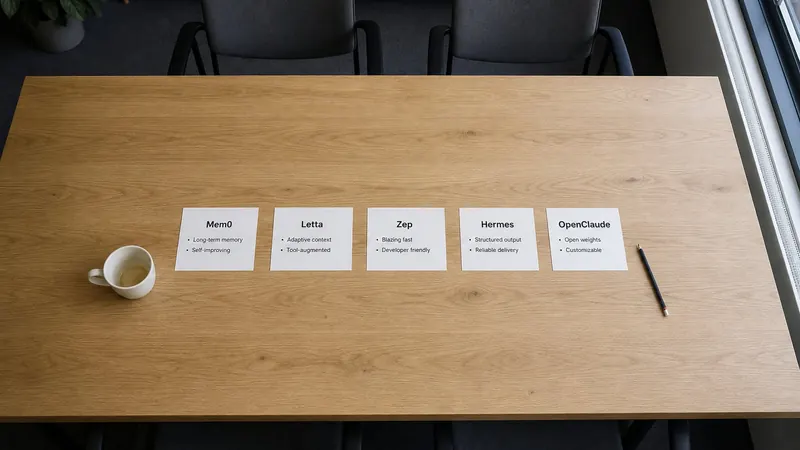
Agent Memory 2026: Mem0, Letta, Zep, Hermes and OpenClaude Compared for Enterprise Decision-Makers
Memory is the layer in 2026 where it is decided whether an AI agent becomes a toy or production infrastructure. Mem0, Letta, Zep, Hermes, and OpenClaude dominate the public debate with different shapes, promises, and price tags for lock-in and compliance. This brief shows which architecture answers which question and what European decision-makers should concretely do in the next three months.
Mem0 reported in May 2026 with its token-efficient algorithm 92.5 percent on LoCoMo and 94.4 percent on LongMemEval, at under 7,000 tokens per retrieval call instead of 25,000-plus for full-context. Zep with Graphiti sits at 63.8 percent on LongMemEval versus 49.0 percent for Mem0 in the direct comparison and reduces latency by up to 90 percent, and it is the only one of the five with SOC 2 Type 2, HIPAA, and GDPR certification. Letta packages MemGPT as a runtime with three memory layers and high lock-in. Hermes Agent by Nous Research, released in February 2026, combines four memory layers in an open-source server agent with 864 commits from 295 contributors between v0.12 and v0.13. OpenClaude formalises write-ahead logging in SESSION-STATE.md as a skill pattern. The right choice follows the use case, not the benchmark: Mem0 for consumer apps, Letta for autonomous agents, Zep for regulated industries, Hermes for open-source servers, OpenClaude for developer-friendly plug-in setups.
Why memory became the decision layer in 2026
Until 2024 large language models were primarily conversation engines. In 2026 they are the control plane for autonomous agents, and memory is the layer where it is decided whether an agent becomes a useful tool or a throwaway demo. Five systems dominate the public debate with different shapes, promises, and price tags for lock-in , compliance, and engineering effort.
- Mem0 research was presented at ECAI 2025 and benchmarks ten memory approaches against LOCOMO; the May 2026 token-efficient update lifts the score to 92.5 percent
- Zep released the Graphiti arXiv paper in January 2025, followed by a 90 percent latency edge in LongMemEval tests
- Letta has turned MemGPT into a production runtime platform with three memory layers modelled on virtual memory
- Hermes Agent was open-sourced by Nous Research in February 2026 and brings four memory layers into an open-source server agent model
- OpenClaude formalises the Super Proactive skill from eleven community skills with write-ahead logging as the core mechanic
The memory architecture decision in 2026 is strategic, not technical. It binds lock-in, compliance, and adaptation for years, not weeks.
Seven dimensions for the comparison
Seven dimensions are enough to put the five systems clearly side by side. Each dimension binds a question an architect has to answer before committing to a vendor.
- Shape: SDK, runtime, graph engine, server agent, plug-in, or product layer?
- Persistence: vector store, three-tier OS model, temporal graph, snapshot plus SQLite, Markdown WAL, or Postgres with pgvector?
- Decision locus: who decides what gets stored, the SDK extractor, the autonomous agent, the graph engine, the ReAct agent, or the application itself?
- Proactive: does the system raise questions on its own or only when the human asks?
- User veto: can the user pause capture, exclude individual topics, consent to sensitive items?
- Audit and undo: how traceable and reversible is a memory change?
- Adaptive ask rate: does the system learn when it is asking too much?
Mem0: memory as an SDK
Mem0 is the thinnest variant, an SDK that bolts onto an existing agent loop. Four operations keep the model lean: ADD, UPDATE, DELETE, and NOOP. The write commitment is low (three call sites), the performance high.
- May 2026 benchmarks: 92.5 percent LoCoMo, 94.4 percent LongMemEval, under 7,000 tokens per retrieval versus 25,000-plus full-context
- Token-efficient algorithm delivers plus 29.6 points on temporal queries and plus 23.1 points on multi-hop reasoning
- Three parallel scoring passes (semantic, keyword, entity) fused at retrieval
- Switch cost to another system: one to two person-days, only three call sites
- Best fit: consumer apps where "remember the user" is the feature
Letta and MemGPT: memory as a runtime
Letta is the most radical answer, a runtime that carries the MemGPT paper's virtual-memory idea through to its conclusion. Agents run inside Letta, not with Letta, paginating their own context with tool calls across three tiers.
Best fit: autonomous agents where long-horizon coherence is the product and the lock-in is acceptable.
Zep and Graphiti: memory as a temporal knowledge graph
Zep does not model memory as vectors over documents but as a temporal knowledge graph. Every edge carries two timestamps: event-time, when the fact held in the world, and ingestion-time, when Zep learned of it. That makes temporal reasoning a first-class property rather than an extension.
- LongMemEval score 63.8 percent versus 49.0 percent for Mem0 in the direct comparison
- Up to 90 percent lower latency in complex temporal reasoning tasks
- SOC 2 Type 2, HIPAA, and GDPR certified; the only one of the five with the full compliance stack
- Validity windows per fact: not "this fact exists" but "this fact held from when until when"
- Best fit: customer support, sales, health, legal, agents with strict audit requirements
Hermes Agent: memory as an open-source server
Hermes Agent by Nous Research, released in February 2026, is the first production-ready open-source server agent with self-improvement. Four memory layers, all in plain-text files, all versionable with git.
-
Layer 1: snapshot
MEMORY.mdandUSER.md, about 3,500 characters, injected into every turn. Bounded, always in context. -
Layer 2: history
SQLite with FTS5, every conversation searchable. No vector index, lexically precise instead.
-
Layer 3: skills
SKILL.mdfiles written by the agent after complex tasks. Reusable solution patterns. -
Layer 4: refinement
New evidence updates old skills. The agent gets better over time, without retraining.
864 commits between v0.12 and v0.13, 295 contributors. That is a developer community, not a vendor update. Best fit: own servers, technical teams, workflows where switching matters. Our deeper writeup sits in the Hermes article: Hermes Agent 2026: The First Production Open-Source AI Agent .
OpenClaude: memory as a plug-in skill
OpenClaude is the community framework around Claude-based agents. The Super Proactive skill bundles eleven community skills into a unified architecture that acts proactively, runs background tasks, and refines itself over time.
-
Write-ahead logging mechanic: every decision, correction, or new fact lands as a timestamped entry in
SESSION-STATE.mdbefore the agent moves on - Scheduled background checks without explicit prompts
- Persistence survives the conversation window
- Markdown-centric: portable, developer-friendly, easy to audit
- Best fit: developer-friendly setups where Markdown files as storage are fine and multi-user isolation is not central
The comparison matrix
A compact synthesis of the seven dimensions across all five systems. The one table European decision-makers really need in 2026 to make a first cut.
| Dimension | Mem0 | Letta | Zep | Hermes | OpenClaude |
|---|---|---|---|---|---|
| Shape | SDK | Runtime | Graph engine | Server agent | Plug-in skill |
| Persistence | Vector store | Three-tier OS | Temporal graph | Snapshot + SQLite + skills | Markdown WAL |
| Decision locus | SDK extractor | Agent autonomous | Graph engine | Agent ReAct | Agent + cron |
| Proactive? | no | via autonomy | no | via skills | yes (skill) |
| User veto | app level | app level | enterprise ACL | not built-in | not built-in |
| Audit / undo | limited | runtime traces | graph history | git-able files | WAL journal |
| GDPR / SOC 2 | self-managed | self-managed | certified | self-managed | self-managed |
European and EU perspective
Four compliance topics overlay every decision in European companies. They shift the point of choice from the performance table to the vendor stack.

- GDPR compliance: Zep is the only one of the five with full certification; Mem0, Letta, Hermes, and OpenClaude require self-managed compliance work
- Data residency: local models and EU-compliant inference backends are possible for all five, but cost speed and money
- EU AI Act : as soon as memory contains personal data or supports decisions, transparency and documentation obligations apply regardless of vendor
- Lock-in risk: Letta is the stickiest (runtime), Mem0 the thinnest (SDK), Zep the most compliance-stable (managed enterprise), Hermes the most open (self-hosted), OpenClaude the most skill-centric
- Teams already familiar with the Karpathy LLM Wiki pattern know the discipline of layer separation, which returns in the architecture choice here
- AI agent sprawl is aggravated by unplanned memory decisions when every department picks its own vendor
What companies should do now
Six concrete steps for the next three months. Order matters.

-
Use case first
Knowledge base, coaching agent, customer-support memory, or coding assistant? Without a clear use case every comparison is useless.
-
Personal vs enterprise
Personal setup (Mem0, Hermes) or enterprise platform (Zep, Letta)? The split decides effort and lock-in.
-
Scale compliance with depth
The more personal data in memory, the stricter the audit needs. Plan the stack choice with data classification, not after.
-
Pilot two systems in parallel
In a clearly scoped pilot, test at least two systems side by side. Benchmark numbers do not replace your own pilot.
-
Build in reversibility
Every memory operation must be reproducibly undoable. Otherwise there is no trust, neither with the user nor at audit time.
-
Decide the backend early
EU-compliant inference or accepted residual risk at US providers. Every option has a price, every one is defensible, but not all are interchangeable.
Whoever makes memory decisions in 2026 should state the use case three times louder than the benchmark table. The architecture follows the task, not the leaderboard.
Challenges and risks
Five risks stand out across all systems.
- Hallucination compounding: false facts in memory are treated as given by later steps and cemented into synthesis entries.
- Token cost scales with memory depth: Letta is most expensive here, Mem0 the leanest. In production this becomes its own budget line.
- Vendor lock-in: especially with runtime models like Letta. Switching takes weeks, not days.
- Privacy drift: memory often runs deeper than the user expects. Without an explicit veto model trust breaks.
- Half-life of truth: in fast-moving domains memory entries go stale before the sources; not every system catches that.
Further reading
Frequently asked questions
None for every case. Mem0 leads the 2026 benchmarks with 92.5 percent on LoCoMo and 94.4 percent on LongMemEval but has no audit model. Zep is the only one of the five with SOC 2 Type 2, HIPAA, and GDPR certification. Letta carries the highest lock-in as a runtime. Hermes is open-source server software. OpenClaude is Markdown-centric. The choice follows the use case, not the benchmark.
RAG pulls chunks from a vector index on every question and assembles an answer. Mem0 extracts facts at write time with four operations, ADD, UPDATE, DELETE, and NOOP, and stores them as persistent memory entries. Mem0's token-efficient algorithm runs under 7,000 tokens per retrieval versus 25,000-plus for full-context approaches.
Zep is the only one of the five with full SOC 2 Type 2, HIPAA, and GDPR certification. Mem0, Letta, Hermes, and OpenClaude require self-managed compliance. With local inference and European backends every system can be run GDPR-compliant, but the work is on the buyer.
High. Letta is not an SDK but a runtime. Agents run inside Letta, not with Letta. Vectorize and TokenMix cite framework lock-in as the most common reason for switching. Migration typically takes two to six weeks. Mem0, by contrast, has three call sites and is swappable within two person-days.
Graphiti is the graph engine behind Zep. Every edge carries two timestamps: event-time (when the fact held in the world) and ingestion-time (when the system learned of it). This makes temporal reasoning a first-class property rather than an extension. In LongMemEval tests Zep reaches 63.8 percent versus 49.0 percent for Mem0 in the direct comparison.
Hermes Agent by Nous Research, released in February 2026, combines four memory layers in an open-source server agent: MEMORY.md snapshot of around 3,500 characters per turn, SQLite with FTS5 for every conversation, SKILL.md files after complex tasks, and a refinement layer. Between v0.12 and v0.13, 864 commits from 295 contributors landed. Hermes is the pick for technical teams that want their own server for their agents.
Let's collaborate
One contact, a team behind it
Thirty minutes on what you're working on, whether grid, metering, market processes, IT architecture or AI. Afterwards you'll know how we'd approach it and who would sit at the table.
Energy and measurement technology since 2010 · innobu GmbH since 2014 · Based in Schleswig-Holstein, Germany
Whoever pitches also delivers: whoever leads the first call stays your contact right through to the steering committee, with established partners in the project. Direct: info@innobu.com