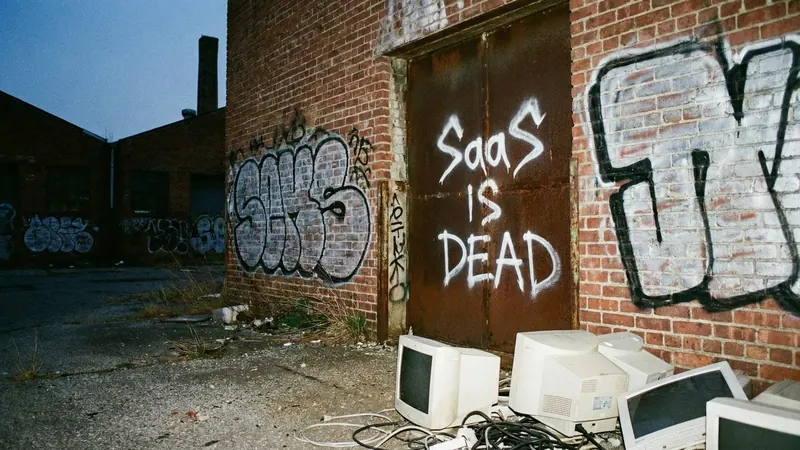
SaaS Under Pressure: AI Shifts the Profits
February 2026 marks a turning point in the global technology economy. Profits in the tech sector are migrating away from traditional SaaS models toward three new centres of gravity: autonomous AI agents, decentralised inference hardware, and critical commodities. A comprehensive analysis for decision-makers and investors.
In February 2026, profits in the technology sector are moving away from traditional SaaS software toward autonomous AI agents, on-premise inference hardware, and critical commodities. Goldman Sachs downgraded the entire software sector, and the forward P/E for software stocks fell from 35x in late 2025 to 20x in early 2026. Energy stocks (XLE) outperformed technology stocks (XLK) by 19 percentage points year-to-date, as capital flowed into physical resources. S&P Global projects a copper supply deficit of 10 million tonnes by 2040, with AI data centres alone adding 4 million tonnes of that demand. Dell reported a record order backlog of $18.4 billion for AI servers, reflecting the shift toward local "AI in a Box" hardware. Goldman Sachs deployed a fleet of autonomous agents running Anthropic's Claude Opus 4.6 for trade reconciliation and compliance work.
The Great Rotation at a Glance
Key Concepts
The Great Rotation
The massive capital shift from software and cloud stocks toward energy, commodity and hardware equities in Q1 2026. Driven by the recognition that physical resources become scarcer and more valuable than code in the AI era.
Service-as-a-Software
The successor model to SaaS. Instead of providing a tool, AI agents deliver the finished work result. Billing shifts to outcome-based pricing (per invoice processed, per case resolved), away from per-seat models.
AI in a Box
The trend of moving AI inference from the public cloud to on-premise hardware. Companies install local AI servers to cut costs, protect data and reduce latency. Dell and HP are the primary beneficiaries.
SaaSpocalypse
Market term for the structural decline of traditional SaaS business models. Goldman Sachs downgraded the entire software sector, arguing that AI agents represent an existential threat.
The Macroeconomic Landscape: Atoms over Bits
In the first weeks of 2026, financial markets delivered a brutal verdict on the existing technology order. A violent sector rotation has taken place, with capital fleeing software stocks and flowing into the "old economy" of energy and commodities.
"Software is dead." Strategist Andreas Steno Larsen argues that AI is no longer merely a tool for software development but a replacement for the software industry as a whole.
The Numbers Behind the Rotation
| Index / ETF | Description | YTD Performance | Sentiment |
|---|---|---|---|
| OIH (Oil Services) | Energy Infrastructure | +40-50% vs. IGV | Bullish |
| XLE (Energy) | General Energy Sector | +14.4% (January) | Safe Haven |
| IGV (Software) | Cloud & SaaS | -30% (since Oct 2025) | Bearish |
| XLK (Technology) | Broad (incl. Hardware) | Underperforming Energy | Mixed |
From "AI Hype" to "AI Substitution"
The years 2023 through 2025 were characterised by the "Training Era". The market assumed AI would function as a "Copilot", a tool making existing platforms like Salesforce, Adobe or Microsoft Office more valuable.
In 2026 the narrative has shifted to Substitution . With the launch of systems like Anthropic's Claude Cowork and OpenAI's Frontier in January 2026, AI agents can operate autonomously at operating system level. They do not need a human user to guide them through a graphical interface. They access data directly, manipulate files and execute complex workflows without intervention.
SaaSpocalypse: Why the Software Model Is Collapsing
The P/E Multiple Collapse
Goldman Sachs downgraded the entire software sector in February 2026. The forward P/E for software stocks collapsed from 35x in late 2025 to 20x in early 2026. A P/E of 20x signals that the market now views software as a mature, low-growth industry (5-10% annually) rather than a high-growth sector (15-20%+).
The Death of the Seat-Based Licence
In a world dominated by autonomous agents, the logic of per-seat pricing breaks down:
- Productivity Paradox: A single AI agent can potentially perform the work of 10 or 100 human employees (customer service, data entry, bookkeeping)
- Revenue Decline: If a company reduces its customer service staff from 100 to 10 thanks to AI, their SaaS bill drops by 90%
- IDC Forecast: The pure seat-based model will be "obsolete" by 2028. Adoption has already fallen from 21% to 15% in just 12 months
Case Study: Salesforce and Agentforce
Salesforce launched Agentforce to counter the threat, but the market remains sceptical. The stock has fallen to 2023 levels because investors fear Agentforce will cannibalise the company's core business faster than new revenue streams can be built.
Goldman Sachs' "Profit Pool" Shift
Goldman Sachs forecasts that by 2030, AI agents will comprise over 60% of the software economy. Value shifts from the Application Layer (SaaS) to the Orchestration Layer (Agents) .
Service-as-a-Software: The New Digital Workforce
From Tool to Colleague
SaaS (yesterday)
"Here is an accounting platform. You have to type the numbers yourself, but we make it easier."
Service-as-a-Software (today)
"We have booked your receipts, reconciled the bank and filed your VAT return. Here is the confirmation."
Goldman Sachs Deploys Claude Opus 4.6
It is telling that the first large-scale deployments of autonomous agents come not from software companies but from their customers. Goldman Sachs has deployed a fleet of autonomous agents powered by Anthropic's Claude Opus 4.6 in 2026:
Trade Reconciliation
Agents match millions of trade transactions, find discrepancies and resolve them autonomously.
Compliance & Onboarding
They review legal documents and ensure adherence to complex regulations (KYC/AML) faster and more precisely than human teams.
Implication for SaaS
Goldman Sachs spent six months building this in-house by hiring engineers from Anthropic, rather than buying off-the-shelf software. Large enterprises are "insourcing" software development using AI.
OpenClaw: Sovereign AI for Everyone
The open-source project OpenClaw (over 68,000 GitHub stars) has become a viral phenomenon. It is a local gateway allowing anyone to run an autonomous agent on their own hardware. Users control their agent via WhatsApp: "Check my sales figures in Excel, create a chart and send it to the team on Slack." The agent executes this autonomously.
For European enterprises with GDPR requirements, this is particularly relevant since all data remains local.
Hardware Supercycle: From Cloud to AI in a Box
The Shift from Training to Inference
In 2023-2025 Nvidia dominated with massive GPU clusters for model training. In 2026 the focus shifts to inference, the daily operation of models. Because cloud inference is expensive ("The AI Bill"), companies are moving computations to their own hardware.
Dell: AI Factories
Record backlog of $18.4 billion for AI servers. Dell sells "AI Factories", ready-to-run packages where companies install a server on-premise and run a model like Llama securely and privately.
HP: PC Upgrade Cycle
Windows 2026 updates require NPUs (Neural Processing Units) for AI features. Companies worldwide must replace their laptop fleets. HP is simultaneously cutting 4,000-6,000 jobs to free capital for AI development.
Memory: SanDisk & Micron
SanDisk reports 61% revenue growth with gross margins of 51.1%. Micron experiences an "AI Storage Supercycle" driven by demand for High-Bandwidth Memory (HBM), without which the fastest AI chips cannot be fed data quickly enough.
Small Language Models and Edge Computing
The development of Small Language Models (SLMs) like Microsoft's Phi-3.5, Google's Gemma 2 and Alibaba's Qwen2 makes "AI in a Box" possible. New Edge AI chips deliver up to 26 tera-operations per second at just 2.5 watts, six times more efficient than traditional CPUs. GlobalData forecasts that 2026 will be the year SLMs gain broad adoption in regulated industries like finance and healthcare.
The Commodity Crisis: The Periodic Table Under Pressure
The AI revolution is no longer virtual; it is industrial. Building data centres, servers and power grids requires physical materials at a scale the world has not seen before.
Copper: The New Oil
Platinum and Strategic Metals
Platinum plays a hidden but critical role in AI hardware: it is used in hard drive coatings for higher data density and is a key catalyst in fuel cells. Many new data centres are installing hydrogen-based backup systems to reduce their carbon footprint. The US officially designated copper as a "critical mineral" in 2025, and China controls roughly 40% of global smelting capacity, creating a strategic vulnerability that drives "friend-shoring" investments.
Energy and Thermodynamics: New Water, New Fire
The physical limit of AI is ultimately thermodynamics: How do we generate enough energy, and how do we get rid of the heat?
Liquid Cooling
AI server racks now draw 60-120 kW (previously 8-10 kW). Air cooling is physically unable to handle this heat. The industry is shifting to direct-to-chip and immersion cooling.
Nuclear Renaissance
Constellation Energy and Vistra see strong share price increases. "Behind-the-meter" deals build data centres directly next to nuclear plants. Governments require new data centres to "bring their own power".
Water Consumption
Traditional data centres evaporate millions of litres. Microsoft and Amazon invest in "waterless" technologies and grey water recycling for dry regions like Arizona and Spain.
Strategic Implications for European Enterprises
GDPR Advantage Through "AI in a Box"
European enterprises benefit disproportionately from the local AI infrastructure trend. With strict GDPR requirements, on-premise solutions from Dell and local SLMs like Llama are more attractive than cloud-based alternatives.
European SMEs Well Positioned
European SMEs that traditionally maintain their own IT infrastructure are well positioned for the "AI in a Box" trend. Existing server rooms can be upgraded to AI factories.
Action Items for European Decision-Makers
- Review SaaS contracts: Evaluate which software can be replaced by AI agents, particularly in customer service, data processing and accounting
- Develop hardware strategy: Plan to build local AI infrastructure based on open models
- Monitor commodity risks: Dependence on copper and rare earths directly affects European supply chains
- EU AI Act compliance: Regulatory requirements favour local agent solutions with full data control
Winners and Losers of the 2026 Rotation
| Category | Losers | Winners | Reason |
|---|---|---|---|
| Sector | Traditional SaaS (IGV) | Energy & Services (XLE, OIH) | "Atoms over Bits" rotation |
| Business Model | Per-Seat Licensing | Outcome-Based Pricing | AI agents reduce human users |
| Hardware | General Purpose CPU | GPU, NPU, HBM Memory | Shift from general to AI inference |
| Infrastructure | Public Cloud (general) | Edge Data Centres & On-Prem | Latency, privacy, cost |
| Commodities | - | Copper, Platinum, Water/Cooling | Physical scarcity in infrastructure build-out |
We are in the middle of a fundamental reallocation of global capital in 2026. The AI revolution has stepped out of the screen and into the real world. It is no longer about who has the smartest chatbot, but who owns the power, the copper and the hardware to run the new global intelligence.
Further Reading
Frequently Asked Questions
The phrase describes the structural collapse of seat-based licensing models. AI agents increasingly replace human users within software platforms, eroding the payment basis (per user/seat). Goldman Sachs has downgraded the entire software sector, warning of an existential threat from AI agents. For enterprises, this means lower SaaS spending but higher investment in AI infrastructure and agent orchestration.
SaaS delivers a tool (e.g. an accounting platform) where you do the work yourself. Service-as-a-Software delivers the finished outcome: The AI books your receipts, reconciles the bank and files your tax return. Instead of monthly flat fees, you pay per invoice processed, per support case resolved, or per line of code audited.
The market rotation follows the logic of "Atoms over Bits". While AI pushes the value of code toward zero (because supply becomes infinite), the value of physical resources rises. Data centres need enormous amounts of power, and the grid cannot keep up. Energy stocks (XLE) have outperformed tech stocks (XLK) by 19 percentage points year-to-date, as investors bet on physical scarcity.
Copper is the physical bottleneck of AI infrastructure. No copper means no power transmission and no data centres. S&P Global forecasts a supply deficit of 10 million tonnes by 2040, with AI data centres alone adding 4 million tonnes of extra demand. A single hyperscale facility can consume up to 50,000 tonnes of copper. Analysts expect copper prices above $13,000 per tonne.
AI in a Box describes the trend of moving AI inference from the cloud to on-premise hardware. Dell sells ready-to-run AI servers with a backlog of $18.4 billion. For European enterprises with strict GDPR requirements, this is particularly attractive since sensitive data never leaves the company. Small Language Models like Phi-3.5 or Llama already run on local hardware.
Analysts at Goldman Sachs and Bank of America see opportunities in data infrastructure and observability providers. Snowflake and MongoDB benefit because AI agents need massive amounts of structured data. Datadog is rated mission-critical since monitoring complex AI systems becomes indispensable. These "best-in-breed" companies form the foundation on which new agent architectures are built.